
You're in a listing appointment. The owner looks at you and asks the question that will decide whether you sign an exclusive or hear “we’ll call you.” “Why are you proposing this price and not another?”
If you’ve worked in the business for years, you’ve probably developed a gut. You can read a street, spot an overpriced property and sense when a neighbourhood is starting to move. But you also know an uncomfortable truth: two experienced agents can visit the same flat and give different valuations — and both will defend them with conviction.
This is where real estate big data comes in. Not as a tech fad or a proptech buzzword, but as a firmer way to decide. It helps set better prices, find the right buyer sooner, prioritise leads and choose the visual message that will make a property stand out. In short, it helps you sell with less improvisation and more judgement.
The End of Intuition Alone in Real Estate
Marta runs an agency that sells well in her area. She has a team, a portfolio and a reputation. Still, three problems repeat every month.
First, she loses listings because another agent promises a higher price. Second, some properties go to market at a “reasonable” price and end up burning out on portals. Third, she wastes time on leads that look interested but never progress. None of this means she’s bad at her job. It means the market has become faster and more complex.
Before, knowing the neighbourhood, checking comparables and relying on experience was often enough. Today, that’s frequently not sufficient. Each property competes with hundreds of signals that change daily: active supply, real demand, absorption speed, buyers’ digital behaviour, changes in nearby services, micro-differences between streets — even between blocks.
Intuition isn’t the problem
Intuition still matters. What’s changed is its role.
Now it works best as the final decision layer, not the only source of truth. The agent who combines experience with data arrives at meetings with stronger arguments, handles objections better and makes fewer costly mistakes. They remain an advisor — but a better-armed one.
Intuition tells you where to look. Data helps you prove why.
Think about a common situation. You have two similar flats a few streets apart, similar square footage and condition. One gets visits from the first weekend. The other barely generates enquiries. If you only look at size, general location and finishes, they seem equivalent. If you examine more detailed data, you might find differences in active demand, buyer profile or the perceived appeal of the immediate surroundings.
What changes when you work with data
Real estate big data doesn’t replace the commercial work. It makes it more precise.
- In listings: you arrive with a valuation you can defend better.
- In pricing: you reduce the risk of being overpriced or leaving margin on the table.
- In marketing: you present the property in ways aligned with probable buyers’ wants.
- In commercial follow-up: you spend more time on contacts with real intent.
According to a study by the Universidad Pontificia Comillas, data analysis in the Spanish real estate sector has enabled predictive models using machine learning, and a supervised model achieved a 40% predictive power using only traditional data. The same study notes that incorporating alternative data significantly improves that predictive capability.
That changes the conversation. It’s no longer “I think this flat is worth this.” It’s “this price better matches what’s happening here and now.”
What Real Estate Big Data Is and How It Works
The simplest way to understand real estate big data is this: it’s like a Waze for the property market.
Waze doesn’t drive for you. It doesn’t replace your knowledge of the city. It analyses thousands of signals at once to recommend the best route based on real-time traffic. Big data does something similar. It won’t sell the house for you, but it helps you choose the right price, timing, message and buyer target.
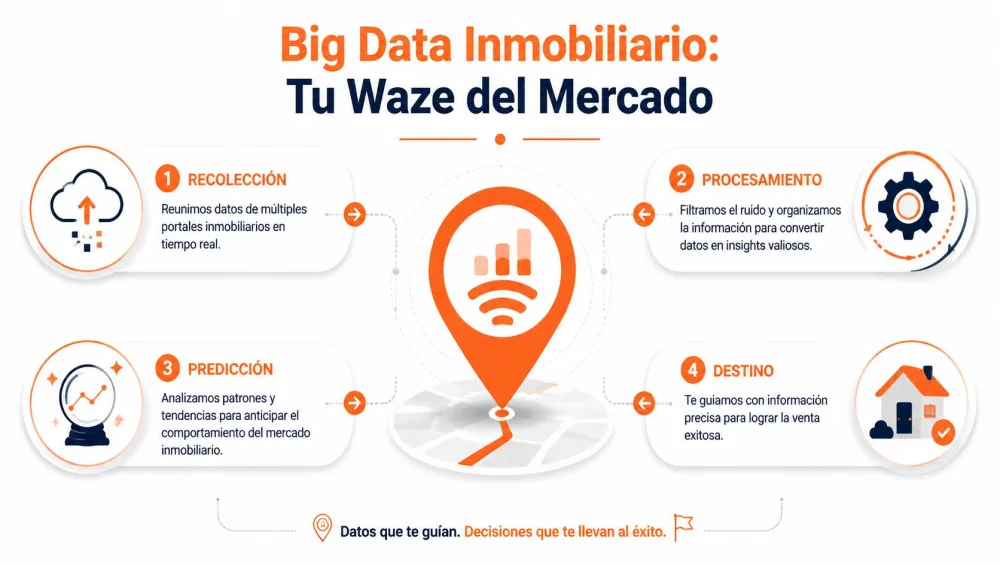
Where the data comes from
When an agent hears “data,” they sometimes think it’s remote or reserved for big companies. In reality, much of the value comes from sources already part of the sector’s daily routine.
Some sources are structured. Others aren’t.
| Tipo de dato | Ejemplo práctico | Qué te ayuda a ver |
|---|---|---|
| Datos de portales | anuncios, tiempo en publicación, cambios de precio | oferta activa y reacción del mercado |
| Datos registrales y catastrales | square footage, antigüedad, características del inmueble | base objetiva del activo |
| Datos demográficos y de entorno | composición del barrio, servicios, movilidad | quién quiere vivir ahí y por qué |
| Datos de comportamiento | búsquedas, clics, patrones de interés | qué demanda existe de verdad |
The key isn’t accumulating data. It’s combining signals.
A property isn’t worth the same just because it matches another in square footage. Environment, current demand, direct competition, ease of access, perception of the area and many other factors that a simple Excel sheet doesn’t capture properly all matter.
What algorithms do
This is where confusion often appears. Many people picture something mysterious. It’s not that complicated.
An algorithm, in this context, is a system that reviews thousands of cases and detects patterns a person can’t process at that speed. For example, it might find that certain types of property sell better on specific streets, or that a particular combination of features generates more demand than expected.
Practical rule: if a pattern repeats across hundreds or thousands of properties, it’s worth measuring. Team memory isn’t enough to capture everything.
That doesn’t mean the machine is always right. It means it offers a much broader basis for decision-making.
In Spain, Tinsa uses advanced algorithms with supply, demand and environment data, increasing valuation accuracy by more than 25% versus traditional methods, according to an analysis published by Bright Data on how big data is transforming real estate. The same analysis notes that Fotocasa uses big data to analyse real demand and has reported conversion improvements of 15–20% in personalised campaigns.
If you want to understand how AI lands in the sector’s commercial processes, this guide on AI for real estate agencies provides useful context.
Why this is more reliable than a single opinion
Individual experience has a natural limit. Each agent remembers deals, objections and local trends. But no professional can observe the whole market at once or mentally update thousands of changes.
Real estate big data can operate at that scale. That’s why it doesn’t compete with your experience — it amplifies it.
Use Big Data to Set Perfect Prices
Pricing correctly isn’t a technicality. It’s the decision that shapes almost everything else: listings, speed of sale, quality of visits, negotiation margin and the owner’s perception.
A poorly set price can ruin a good property. If you go too high, the listing loses traction. If you go too low, you generate quick interest but may sacrifice value and credibility. Real estate big data helps precisely where mistakes hurt most.
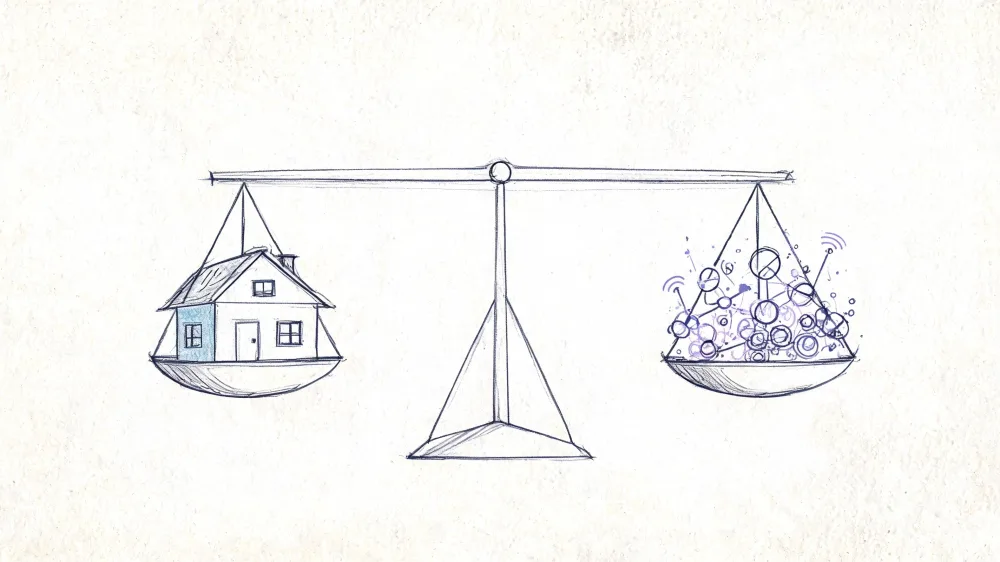
From simple comparables to real context
Traditional comparative analysis remains useful. The problem is using it as the sole basis.
Two comparables can look similar on paper but behave differently on the market. One might be in a microzone that’s more sought-after. Another might coincide with a supply spike. One appeals more to replacement buyers. Another attracts investors. That level of detail rarely fits into a quick manual valuation.
Machine learning models incorporate many variables at once. According to BBVA’s analysis of innovative technology in real estate, these models can predict prices with over 90% accuracy, reducing mean valuation error from the 15–20% range of traditional methods to under 5%. The same analysis adds that variables like public transport density can raise prices by up to 12% in areas with a new metro line.
That doesn’t mean you must accept any number a tool spits out. It means you can value with a much richer basis.
How the conversation with the owner changes
When an owner says “the neighbour asked more,” they often don’t need a flashy sales pitch. They need proof.
With data, you can better defend three points:
- What the real competition is asking, not what they remember.
- How demand responds to similar properties.
- Which microzone factors justify your proposal.
A strong agent no longer just shows printed comparables. They show context. They explain why one street performs differently from a nearby one. They argue why a property must be precisely positioned from day one. They turn an opinion into a data-backed recommendation.
When the owner understands that the initial price affects market speed and perception, they negotiate differently.
What to check before listing a property
You don’t need to build a data science department to apply this. You do need to get used to reviewing more complete signals.
-
Competitors active today
Look at what’s competing now, not only what sold months ago. -
Absorption rate
A neighbourhood with live demand tolerates different pricing than an area with slow stock. -
Environmental signals
Transport, nearby infrastructure and urban changes can influence value. -
Microzone differences
The same postal area can hide very different behaviours between streets.
This approach also improves prospecting. If you want to deepen how to translate market data into a commercial valuation proposal, this guide on real estate pricing can be a useful reference.
A small change with a big impact
Many agents don’t lose listings from lack of skill. They lose them because they arrive with a correct valuation but explain it worse than a competitor’s inflated promise.
Real estate big data gives you a concrete advantage. It lets you better justify the number you propose. And in this business, a well-justified number is worth a lot.
Optimise Your Marketing and Lead Capture
Much real estate marketing still works like a megaphone: list the property, run a campaign and hope the “right buyer” responds.
That approach still generates contacts, but it wastes budget and sales time. Real estate big data changes that logic. Instead of talking to everyone, it helps identify which profile is most likely to be interested in a specific property and what message will resonate with that profile.
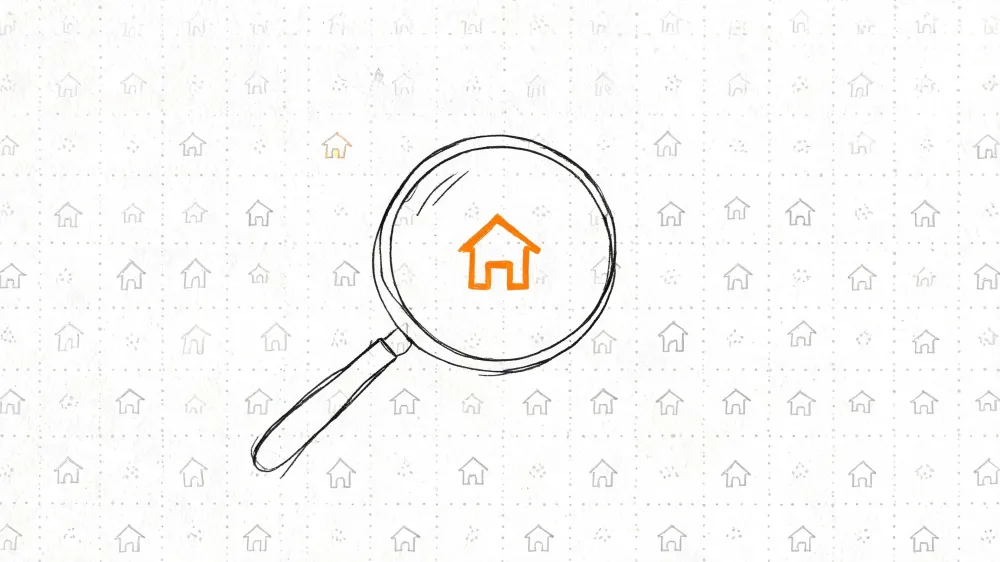
From broad campaigns to micro-segmentation
Not all buyers value the same things. A young couple may prioritise light, design and nightlife access. A family usually reacts better to layout, storage, schools and outdoor space. An investor focuses on yield, liquidity and repositioning potential.
By analysing search behaviour, ad interaction and demand patterns, you can stop writing “for everyone” listings and start creating campaigns that speak the language of a specific buyer.
According to [Gloval’s analysis of big data and real estate investment](https://www.gloval.es/blog/big-data-inversion-real estate agency/), advanced segmentation in Spanish real estate marketing achieves conversion rates 35% higher, and automated machine learning campaigns can reduce CAC by 40% by dynamically personalising content for microsegments.
That has an immediate practical implication: less wasted spend, more useful contacts.
What changes in the agency’s day-to-day
You don’t need more complex campaigns. You need more specific ones.
Try thinking of each property like this:
| Tipo de activo | Perfil probable | Mensaje que suele encajar |
|---|---|---|
| apartment pequeño bien ubicado | comprador de primera vivienda o inversor | comodidad, conexión, facilidad de entrada |
| vivienda familiar | familia en cambio de etapa | espacio útil, vida diaria, entorno |
| inmueble para reformar | inversor o comprador con visión | potencial, transformación, margen |
This simple exercise already improves listings, landing pages, creatives and commercial follow-up.
Lead scoring prevents wasted time
Another very useful use of big data is lead scoring. It sounds technical, but the idea is simple: rank leads by their probability of progressing.
Not all contacts have equal commercial value. Some open multiple emails, repeatedly view the listing and ask specific questions. Others just browse. If the system detects higher-intent patterns, the team can prioritise calls, visits and follow-up more effectively.
Useful tip: don’t just measure how many leads come in. Look at which leads show intent and which reach closing.
The goal is not more leads. It’s better leads.
An agency can feel busy and still be chasing low-quality contacts. Real estate big data helps escape that trap. It forces a more profitable question than “how many leads did we generate?” The right question is “what type of lead are we generating and what’s their purchase probability?”
When you start working this way, marketing stops being diffuse spending and becomes a much more precise commercial tool.
Turn Data into Sales with Intelligent Visual Marketing
Knowing what the buyer wants is only half the job. The other half is presenting the property so that the buyer understands it and wants it.
This is where many strategies break down. The agency already has data. It knows that in one area turnkey properties perform better, or that a given buyer profile values home office, natural light or terraces. Yet it publishes flat, empty or generic photos and the message loses power.

Data tells you what to emphasise
Real estate big data can point out which attributes generate more interest for a type of asset or a specific microzone. That intelligence guides your visual focus.
If demand in a neighbourhood comes from families with remote workers, highlight order, functionality and everyday life. If urban buyers dominate, emphasise sense of space, design and flexibility. If the asset fits an investor profile, show potential, layout and repositioning options.
We’re not talking only about photography. We’re talking about visual storytelling.
Examples linking insight to creative
Consider this sequence.
- Data shows buyers who work from home respond well in that zone.
- The property has a small bedroom with no clear use.
- The most effective visual may not be a photo of that room empty.
- It may be much better presented as a functional home office.
Another example.
- Demand concentrates in buyers seeking outdoor space.
- The terrace is empty and says nothing.
- The correct visual isn’t a cold shot of the floor.
- It’s an image that helps imagine breakfast, relaxation or a casual gathering.
A good visual doesn’t invent a property. It makes visible the value the right buyer was already seeking.
From insight to commercial action
This is the practical part. When the agency connects demand analysis with agile visual production, it gains speed.
You no longer have to refit the whole property or wait weeks to test a different approach. You can adapt images, videos or virtual tours according to the commercial angle that best suits the asset and audience.
An analysis by Etikalia on real estate big data highlights precisely this gap between data and visual execution. It notes that while the Spanish proptech market grows 25% annually, agents can use big data to identify properties in high-demand areas and rely on visual tools to generate personalised materials in minutes, increasing conversions by 30–40% when visual marketing aligns with market expectations.
If you’re interested in this stage of the buyer journey, this guide on virtual tours for realtors shows how visual formats influence lead qualification.
Which visual assets are worth adapting
Not every property needs the same package. But you should decide based on commercial data.
- Photos enhanced: to correct a weak first impression.
- Virtual staging: when the space exists but is hard to read empty.
- Short video: useful to highlight lifestyle or flow between rooms.
- 360° virtual tour: especially useful when layout is a decisive factor.
The principle is simple. Data tells you what the market values. Intelligent visual marketing turns that information into a presentation that accelerates decisions.
Practical Implementation and Ethical Considerations
The good news is that getting started with big data for real estate doesn’t require building a giant system. Most agencies don’t need more technology — they need better questions and a more disciplined process.
The bad news is that if it’s done poorly, you can make bad decisions or run into privacy problems. That’s why it’s wise to start with a simple roadmap.
A realistic plan for an agency
Start with a single use case, not a total transformation. The best entry points are usually one of two: pricing or marketing.
Then create a weekly review routine. Not everyone on the team needs to become an analyst. What is needed is someone who consistently watches for patterns and translates them into business decisions.
-
Choose a clear objective
For example, improve the quality of initial valuations or better segment campaigns. -
Define the sources you will actually use
Portals, CRM, your own historical data, surrounding-area data and commercial behavior. -
Create an operational reading
Data only matters if it ends in action. Adjust price, change the listing, prioritize leads or rethink visuals. -
Measure before and after
If you don’t compare, you won’t learn. Track lead generation trends, lead quality, time to viewing and negotiation outcomes.
What skills really matter
Many managers think they need highly technical profiles. Sometimes they don’t.
They need people who can ask specific questions. For example, “what type of property is getting the most real demand in this micro-area?” or “what signals appear before a drop in interest in a listing?” That way of questioning already raises the business’s level.
A good agency doesn’t use data to look sophisticated. It uses data to make better decisions.
You don’t need to understand the algorithm in detail. You need to know when to trust the signal and when to cross-check it with commercial judgment.
The legal and ethical limit
This is an area to take seriously. Working with data doesn’t give you a free pass to collect or combine any information.
According to the analysis published by real estate agency BSV sobre cómo el big data está cambiando el mercado inmobiliario, in Spain misuse of data, including geolocated data, can lead to significant sanctions under the GDPR. That same analysis indicates that only 20% of agencies comply with anonymization of alternative data, and that in rural areas with sparse data models can fail up to 30% of the time.
Two lessons follow.
- Privacy first. Work with aggregated, anonymized data that is relevant to the commercial purpose.
- Don’t over-rely on weak models. In low-data markets, professional judgment remains decisive.
How to know if it’s working
Don’t rely only on closed sales. There are earlier signals that tell you if you’re heading in the right direction.
- Better price defense: less friction with sellers during listing.
- Higher lead quality: fewer irrelevant contacts.
- Sharper listings: better commercial response to the property’s positioning.
- More consistent processes: fewer arbitrary decisions between agents.
Useful adoption of big data for real estate looks less like an instant revolution and more like an agency that starts making fewer repeated mistakes. That is the real progress.
If you want to move from analysis to visual execution without complicating your workflow, Pedra helps you turn photos or floor plans into materials ready to market a property. You can create enhanced images, virtual staging, videos and immersive tours from a single platform, quickly and without relying on multiple different tools.