
You’re probably in one of two situations. Your agency has used the same real estate logo for years and it no longer fits how you attract clients. Or you’re starting out, opened Canva, tried three roof icons and two elegant fonts, and still feel like everything looks like another agency.
That block is normal. In real estate, the issue is rarely “making something pretty.” The issue is building a brand that inspires trust at a glance and works on Idealista, Instagram, a billboard, a vertical video and a virtual tour — all while staying coherent.
Context matters. In Spain the real estate market remains active. The Real Estate Registry Statistics show that in 2022 there were 1,279,000 properties transferred by sale, a 13.2% increase, and the average price per square metre for free-market housing was €1,623, 4.5% higher than in 2021, according to the Portal Estadístico Registral of the Colegio de Registradores. In a market like this, visual identity is not a minor detail — it’s a commercial tool.
Why Your Real Estate Logo Is More Than an Image
A buyer doesn’t trust you because you picked the right blue or a clean typeface. They trust you because those elements together convey order, seriousness and consistency — and that happens in seconds.
When someone sees your brand on a lead board, then in an Instagram story and later in a property video, they need to recognise that everything belongs to the same agency. If each piece appears made by a different company, perception drops. And when perception drops, trust drops.
What a Good Real Estate Logo Actually Does
A good real estate logo performs four functions at once:
- Identifies your agency quickly.
- Filters expectations about your positioning. A brand for urban new builds doesn’t communicate the same as a boutique luxury agency.
- Organises your materials so everything looks professional.
- Helps people remember your name when they see you on another channel.
Practical rule: if your logo only works on a business card but fails as a profile photo, in a vertical video or as a watermark, it’s not solved.
Many agents try to fix a commercial problem with an aesthetic decision. They change the icon, add a key, try a more modern house, add a crown or a skyline. But if they haven’t defined who they want to attract and what they want that person to feel, the result is usually a serviceable but forgettable logo.
The Most Common Mistake
The mistake isn’t having a simple logo. The mistake is having a generic logo.
Visual competition in real estate is fierce. Almost all brands use similar resources: blue, black, gold, initials, roofs, keys, buildings. That forces you to work with more criteria, not more effects.
Try this simple test. Look at your current logo across these placements:
| Support | Key question |
|---|---|
| Profile photo | Is the name legible or is it just a blotch? |
| Real estate portal | Does it stand out against other agencies? |
| Story or Reel | Is it recognisable small and in vertical format? |
| Shopfront sign | Does it maintain presence from a distance? |
If it fails in two or more, you don’t need a “nice redesign.” You need a better-thought-out visual identity.
The Foundations of Your Visual Identity
Before choosing colours, define the strategy. An effective real estate logo isn’t born in Illustrator. It’s born from business decisions.
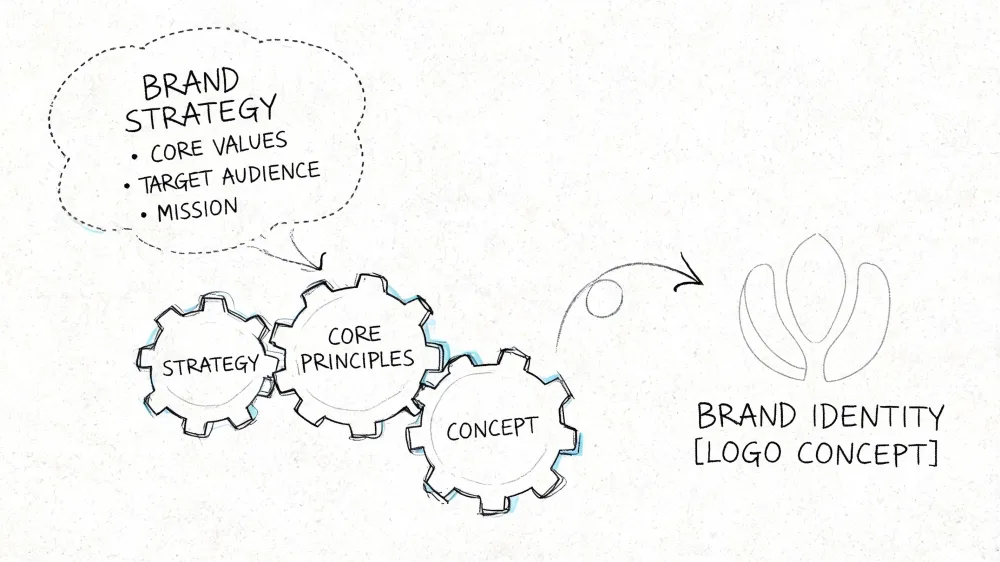
Start with the client, not the icon
Don’t design to please yourself. Design to be recognisable and credible to the client you want to attract.
Ask and answer these questions in writing:
-
Who do you sell to most often?
Young families, investors, international buyers, replacement home sellers, developers, short‑term rentals. -
What do they value when they choose you?
Approachability, speed, negotiation skills, visual presentation, local knowledge, discretion. -
What makes you different from the agency next door?
Local specialisation, premium product, exclusive listings, visual marketing, very personalised service.
These answers change the direction of the design completely. An agency focused on young families will fit better with a clearer, friendlier, more direct brand. A luxury-focused agency usually needs a more restrained, selective presence.
According to the analysis shared by Wasi on logo renewal, in Spain minimalist logos are 55% more successful at connecting with young families using warm colours like #FF6B35, while 40% of luxury brands choose black-and-gold combinations. The same analysis recommends reviewing 20 to 30 local competitors to spot clichés and differentiate.
Make a quick map of your local competition
You don’t need a complex market study. You need to observe with intent.
Create a folder with logos from agencies in your area and classify them like this:
- Too similar to each other
Houses, roofs, keys, linear buildings, monograms without context. - Good digital presence
Simple, legible brands with small versions that hold up on mobile. - Misaligned with their client
Luxury logos for a generalist agency, or overly casual brands for high‑value operations.
If you do this exercise well, you stop designing “in the abstract” and start finding real positioning gaps.
Define three pillars before sketching
I usually ask for three firm decisions before starting design:
- Brand personality
Could be sober, approachable, urban, premium, technical or innovative. - Main promise
“I guide you clearly” is not designed the same as “I sell exclusive properties.” - Context of use
Your logo will live on portals, WhatsApp, videos, capture PDFs, stories and shopfronts. That conditions everything.
If you want to organise these decisions before working on design, a useful tool is a branding guide for real estate agencies that helps fix tone, style and applications ahead of creating pieces: Brand Guidelines
Translate strategy into visual decisions
This is where many get stuck. Strategy doesn’t stay as nice phrases. It becomes concrete choices:
| Strategic decision | Possible visual translation |
|---|---|
| Agency for young families | Simple shapes, warm tone, clean typography |
| Boutique luxury | Fewer elements, more white space, elegant contrast |
| Neighbourhood specialist | Approachable brand, legible, strong name presence |
| Innovative profile | Abstract symbol, adaptable system, very clear mobile version |
Do this part well and design stops being a matter of taste and becomes a commercial fit.
Anatomy of a Successful Real Estate Logo
A real estate logo works when each piece has a clear task. Colour, type, shape and symbol aren’t just decoration — they build a specific perception.
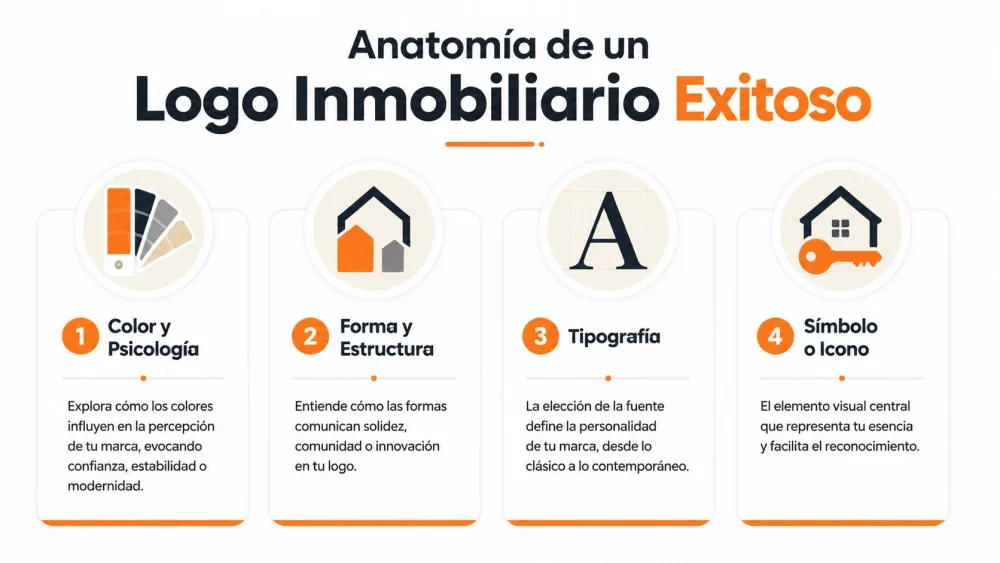
Colour and psychology
Colour remains one of the most visible decisions. In real estate blue works for an obvious reason: it’s associated with stability and trust. According to Fotocasa’s guide on corporate identity for agencies, 70% of the most trusted real estate logos in Spain use blue tones like #003366.
That doesn’t mean you should copy it blindly. If your local market all uses the same dark blue with a little house, the best move may not be to “join in” but to find another way to convey solidity.
A practical use of colour might be:
- Dark blue for security and professionalism.
- Black with gold accent for exclusive product.
- Warm tones if your brand wants to feel more accessible and contemporary.
- A short palette to simplify digital and print applications.
Typography that communicates
Typeface defines character. A sans serif like Montserrat often works well when you want a clean, modern brand that’s easy to read on screen. A serif can bring sophistication, but it also needs careful handling to avoid feeling stiff or dated.
You rarely need three different fonts. In fact, almost never advisable.
A good rule: if your agency name isn’t legible in a thumbnail, the typeface isn’t helping the business.
The problem with obvious icons
The generic house is the sector’s big cliché. It seems safe because it “explains” what you do, but it usually does the opposite — it lumps you in with everyone else. Fotocasa’s guide indicates that cliché symbols like houses appear in 80% of failed logos and reduce brand differentiation by 40%. That matches what I see in brand reviews: weaker logos aren’t usually ugly — they’re interchangeable.
What to use instead of a generic house
Better options depending on positioning:
- Well-built initials if your trading name has strength.
- Abstract forms when you want a contemporary brand.
- Geometric structures if you aim to convey order and architecture.
- Pure wordmark when the value is in the name and local reputation.
A combination that often works
A solid formula for many small and medium agencies:
| Element | Recommendation |
|---|---|
| Name | High priority, very legible |
| Symbol | Optional, simple and secondary |
| Main colour | One dominant and one support |
| Mobile version | Simplified, without fine details |
Shape matters more than it seems
Angular shapes convey firmness and structure. Curves soften perception. A very busy logo may look “crafted,” but digitally it almost always loses impact.
Think about where a client will first find you. Often it will be on a small screen. Clarity wins there.
“Pretty” isn’t enough. Your logo must be recognisable small, correct large and consistent across formats.
Three Ways to Create a Professional DIY or AI-Assisted Logo
There’s no single correct way to create a real estate logo. The best option depends on three variables: budget, urgency and how clear your strategy already is.
Option 1: DIY with Canva or similar tools
DIY works when you’re starting, need speed and don’t want to invest much yet. Canva, Adobe Express and similar tools can produce a respectable result if you start from a clear idea.
The problem arises when you use templates without criteria. That’s how logos end up looking like a mix of a bank, an accounting office and a developer.
DIY fits if:
- You have a very simple brand and a strong name.
- You can avoid clichés instead of choosing the first thing that “feels real estate.”
- You will validate quickly and iterate later.
It’s not suitable if your agency competes where visual perception matters from first contact.
Option 2: Work with a professional designer
When the brand needs direction, a good designer doesn’t just draw — they translate business into visual identity.
The difference is the process. A professional asks about ideal client, competition, usage contexts, commercial tone and objectives. That’s why strategic alignment is usually better.
A useful stat: hiring a professional designer for a real estate logo has an 85% success rate in strategic alignment, versus 40% for generic automatic generators. That contrast appears in the cited analysis of logo renewals in the Spanish real estate market.
Option 3: Use an AI tool
Here it helps to separate two things. A well-used AI tool can speed up the process a lot. A generic automatic generator without brand context tends to produce correct but undifferentiated results.
AI works particularly well to:
- generate quick visual directions,
- test variations,
- adapt formats,
- create logo applications in real assets.
Where it fails is strategy, if nobody defined it first. If you don’t know who you’re speaking to, AI won’t either.
Comparison of Logo Creation Methods
| Criterion | DIY (e.g. Canva) | Professional Designer | AI Tool |
|---|---|---|---|
| Speed | High | Medium | High |
| Initial cost | Low | Higher | Variable |
| Differentiation | Highly dependent on taste | High if briefing is good | Irregular if generic |
| Ease of use | High | Not applicable | High |
| Strategic depth | Low | High | Medium if based on a good brief |
| Quality of final files | Depends who creates it | High | Depends on the tool |
| Risk of cliché | High | More controlled | High if it uses templates |
How to decide without making mistakes
If you’re starting and need a first functional version, DIY will do. If you’re already billing, getting exclusive listings or competing on trust, a professional designer is generally the safest option. If you need speed and many digital applications, AI can help — but only if you feed it a clear direction.
The right question isn’t “what costs least.” It’s “which method gives me a brand that helps me sell better.”
Integrate Your Logo into Modern Digital Marketing
Having a good logo and using it poorly is more common than you think. Many agencies invest time designing a logo but then apply it incoherently: changing colours, adding ad‑hoc backgrounds, distorting the file, placing it differently across pieces or simply forgetting it in videos and tours.
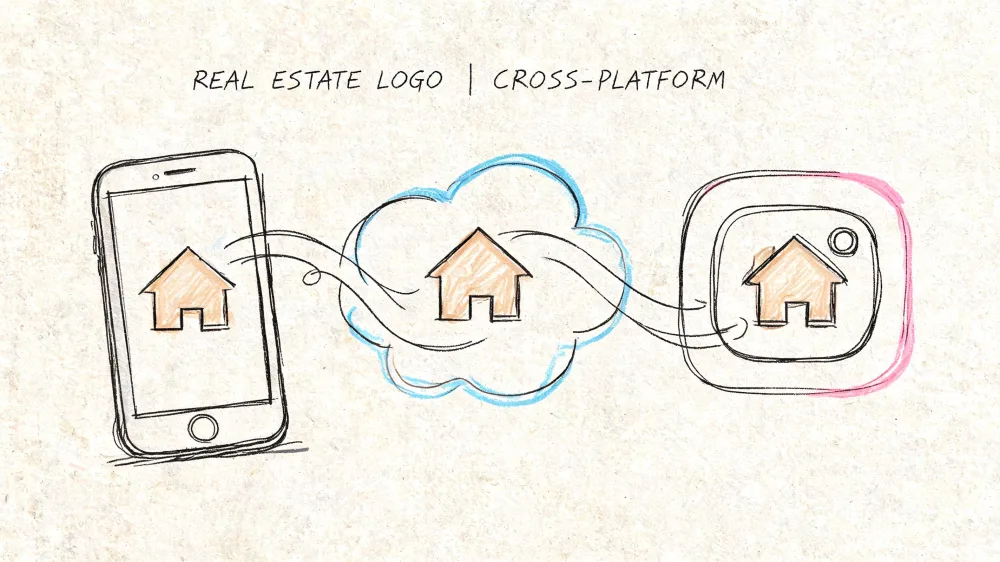
According to an AEI study from 2025, only 12% of real estate agencies in Spain integrate their logos consistently in videos and interactive tours, causing a 45% drop in brand recognition.
Where incoherence shows most
Today’s client sees your brand in fragments. First they find you on a portal. Then they look at your Instagram. Then they get a PDF, a WhatsApp or a property video. If each asset uses a different version of the logo, the cumulative effect disappears.
Check these touchpoints:
- Real estate portals
Profile photo, agency cover, branding on featured images. - Social networks
Avatar, story templates, carousels, Reels and thumbnails. - Commercial pieces
Capture dossiers, property sheets, email signatures, presentations. - Immersive assets
Property videos, 360 tours, renders and AI-generated pieces.
What good integration means
It doesn’t mean making it huge everywhere. It means using it with criteria.
For example:
| Asset | Recommended application |
|---|---|
| Vertical Reel | Small, stable logo in one corner |
| Virtual tour | Visible but not intrusive brand mark |
| Commercial PDF | Consistent header and horizontal version |
| Profile photo | Simplified variant or legible emblem |
The best integration reinforces the brand without disrupting the user experience.
Videos and tours are not extras
This is where many brands get stuck in the past. They still think of the logo as static, while much attention today is won with dynamic pieces.
If you publish walkthroughs, before-and-afters, property videos or interactive tours, decide now:
- which version of the logo goes in video,
- where it appears,
- the minimum size,
- whether it has a background,
- and how it adapts to vertical and horizontal formats.
For practical ideas on applying this in real campaigns, check these real estate marketing ideas for digital channels: Top Real Estate Marketing Ideas to Boost Sales in 2025
A visual example helps bridge the gap from a static brand to an applied, motion-ready brand:
The rule that best protects your brand
Use fewer versions, not more. One primary, one secondary and one simplified version usually suffice. When an agency creates too many variants without rules, it loses consistency.
Also put two basic rules in writing:
- Where the logo is never placed
For example, over visually noisy areas. - What is never modified
Colour, proportion, typeface, shadows or improvised effects.
That prevents every new ad or collaborator from “reinventing” your brand.
Final Deliverables: File Formats and Brand Guidelines
Design doesn't end when you approve the logo. It ends when you have the correct files and basic rules to use them properly.
File formats you must request
Don't accept just a PNG sent over WhatsApp. You need an organized delivery.
These are the essentials:
- Vector SVG
For web, clean scaling, and uses where size varies a lot. - PNG with transparent background
For presentations, social media, portals and documents. - Color and black-and-white versions
For dark or light backgrounds and simple print jobs. - CMYK print file
For banners, business cards, brochures and signage.
If you already have a logo but not the proper formats, you can convert basic files with a free image format converter, although ideally you should request the originals properly exported.
Your brand guide can be simple
You don't need a huge document. One well-made page solves a lot.
Include at minimum:
| Element | What it should define |
|---|---|
| Main logo | Official version |
| Variants | Horizontal, vertical, simplified |
| Colors | HEX, RGB and CMYK |
| Typefaces | Primary and secondary |
| Incorrect uses | Do not stretch, do not change colors, do not add effects |
| Spacing | Minimum clear space around the logo |
Agencies that use a complete brand identity guide, even a simple one, see a 35% increase in brand recognition in local campaigns, according to Fotocasa's corporate identity guide.
Final tip: store everything in a clear folder. "Main logo", "white logo", "favicon", "print", "social". It seems basic, but it saves time every time you launch a new piece.
A good real estate logo not only looks professional. It's used well, adapts well and maintains the same personality across all channels.
If you want to take that identity beyond the logo and turn property photos into enhanced images, property videos and virtual tours with a coherent visual presentation, Pedra lets you create real estate marketing assets from a single place and keep your brand more organized in every listing.