
If you work as an agent today, you’re probably juggling three problems at once. It’s hard to source good stock, hard to filter serious buyers, and hard to defend fees in an environment where many competitors promise the same thing. The result is a high-activity business that doesn’t always deliver healthy margins.
This is where the personal shopper inmobiliario comes in — as an evolution of the agent, not a parallel figure. It’s not about abandoning the craft. It’s about switching sides of the table, professionalizing the process and building a service the client buys for expertise, not impulse.
The Big Real Estate Opportunity in 2026
The traditional agent competes for mandates. The personal shopper inmobiliario (PSI) competes for trust. That difference completely changes the business model.
If you rely only on listings, you depend on stock, portals, cold calls and owners who compare commissions. If you work as a buyer’s representative, you sell judgment, screening, negotiation and risk control. The service stops being “showing properties” and becomes “preventing costly mistakes.”
This shift isn’t marginal. The AEPSI grew 33% year-on-year in membership during 2020, and the number of PSI professionals was expected to increase tenfold in the following years, according to Fotocasa Pro’s analysis of AEPSI’s growth (https://blogprofesional.fotocasa.es/la-asociacion-espanola-de-personal-shopper-inmobiliario-aepsi-crecio-un-33-en-2020/). For an ambitious agent, that matters for a simple reason: demand rewards the professional who best accompanies the buying decision, not the one who publishes the most listings.
What’s Changing in the Agent’s Work
Today’s buyer arrives more informed, but not necessarily better prepared. They browse portals, save listings, compare neighbourhoods and fall into loops of indecision. Many agents waste hours on viewings that don’t lead to offers because the client lacks clear criteria, or because nobody has done the serious work of selection and validation.
A personal shopper inmobiliario brings order to that chaos with a method:
- Define a clear mandate with the buyer before going to market.
- Filter real options instead of forwarding listings.
- Protect the transaction through technical, documentary and negotiation analysis.
- Reduce friction so the client advances with confidence.
The agent who only opens doors competes on price. The agent who reduces risk competes on value.
If you work with first-time buyers, it’s helpful to complement your service with practical resources about the real costs of buying, like this advisory on costs for your first home (https://tutramitefacil.es/2026/04/07/gastos-en-la-compra-de-una-vivienda-guia-completa-2026/). It helps ground expectations and improves the quality of the initial meeting.
Where the Advantage Lies for 2026
The opportunity isn’t in “doing a bit of everything.” It’s in specialising the service and packaging it as a premium proposition. Agents who want to get ahead should follow real estate market trends (https://pedra.ai/blog/real-estate-market-trends) to spot where value is shifting: less generic intermediation, more actionable advice.
In 2026, the professional who earns more won’t necessarily be the one with the most listings. It will be the one who has turned knowledge into a repeatable, billable and defensible process.
What a Personal Shopper Inmobiliario Is — and Isn’t
A personal shopper inmobiliario represents the buyer. That’s the core point. They don’t prioritise marketing a proprietary portfolio, they aren’t starting from a property that needs to be sold, and they shouldn’t be focused on “placing stock.”
This causes confusion because many agents say they “also advise buyers.” Sometimes that’s true. But advising a buyer as part of an intermediary sale is different from having an explicit mandate to defend only the buyer’s interests.
The Real Difference Is Representation
When a client hires a PSI, they pay for independent judgment. The value isn’t only in searching. It’s in selecting, discarding, identifying problems, negotiating with information and accompanying the purchase through to the notary.
A traditional agent can do this well — even very well. But their commercial structure usually starts from the property. The PSI starts from the buyer’s need.
| Characteristic | Traditional Real Estate Agent | Personal Shopper Inmobiliario (PSI) |
|---|---|---|
| Primary client | Typically the seller or owner | Buyer |
| Starting point | Captured stock or marketed properties | Buyer’s needs, budget and criteria |
| Interest represented | Sale / closing the property transaction | Buying the right property for the client |
| Search focus | Often centred on own stock and collaborations | Scours the market per the client’s mandate |
| Commercial relationship | Intermediation around an asset | Professional buyer representation service |
| Fees | Usually tied to sale of the property | Agreed with the buyer for the service |
| End goal | Close a deal | Buy well — fewer mistakes, better fit |
What a PSI Is Not
Don’t idealise the role. A PSI isn’t a magician, an automatic “bargain finder,” or someone who can single-handedly cover every critical area of a purchase.
It doesn’t work when:
- They accept any client without qualification and end up chasing shifting demands.
- They confuse volume with service and send dozens of properties without criteria.
- They promise independence but push deals where they’re more comfortable.
- They operate without technical or legal cover and turn a complex purchase into a lottery.
If your service doesn’t change the quality of the buyer’s decision, you’re not operating as a personal shopper inmobiliario. You’ve only changed the label.
The Right Mindset
The deep change is this: the traditional agent thinks inventory. The PSI thinks mandate, process and client protection.
You see that difference in the initial meeting, how the search is structured, how options are presented and how an offer is defended. You also see it in the type of client you attract: less curious, more committed.
Benefits Driving Client Demand
Buyers hire a PSI when they understand that buying well isn’t about seeing more homes. It’s about seeing the right ones, discarding the wrong ones quickly and negotiating with information.
The commercial argument shouldn’t sound aspirational. It should sound useful. The client buys three things: time, protection and competitive advantage.
Broader Access and Better Negotiation Power
The PSI’s most powerful advantage is access and filtering. According to Fotocasa Pro on the work of the personal shopper inmobiliario (https://blogprofesional.fotocasa.es/personal-shopper-inmobiliario/), a PSI accesses 100% of the supply, including 25–35% off-market properties, which enables negotiations with 12–18% better improvement margins compared to conventional transactions.
That changes the conversation with the client entirely. You’re no longer selling “I’ll accompany your search.” You’re selling access to opportunities they likely wouldn’t see and a better-prepared negotiation table.
Three Benefits Buyers Grasp Quickly
- Real time savings. The buyer stops reviewing repeated, duplicate or poorly presented listings and receives a reasoned selection.
- Lower chance of overpaying. A good PSI compares, contrasts and negotiates with market context, not intuition.
- Fewer avoidable mistakes. A serious service doesn’t end at the viewing. It continues with document checks and transaction validation.
The buyer doesn’t need more portals. They need less noise and better decisions.
How to Explain Value Without Sounding Defensive
Many agents fail here because they justify the service by listing their effort: “I’ll spend many hours,” “I’ll do many viewings,” “I’ll move many contacts.” That doesn’t sell well.
What works is translating your work into practical outcomes:
| What the PSI does | What the client perceives |
|---|---|
| Filters the entire market | I receive fewer options, but better ones |
| Activates off-market contacts | I have more chances to find the right fit |
| Negotiates with comparables and context | I don’t go blind into price discussions |
| Coordinates inspections and documentation | I buy with less uncertainty |
Where Demand Explodes
This service fits particularly well with buyers who value opportunity cost: busy buyers, families that don’t want to make mistakes, relocated professionals, international clients and small investors who need judgement more than superficial accompaniment.
Presented this way, the fee stops being seen as an extra cost and becomes understood as a defensive layer and a buying tool.
The Business Opportunity for Real Estate Agents
For an ambitious agent, moving to a personal shopper inmobiliario role isn’t lateral — it’s an upgrade in positioning.
You stop competing only on visibility and start competing on specialization. That improves the commercial conversation, elevates service perception and reduces dependence on traditional sourcing markets.

Lack of regulation also creates an advantage
In Spain, the profession lacks standardised official regulation and certification, according to an interview in VIA Empresa about the personal shopper inmobiliario role (https://www.viaempresa.cat/es/afterwork/entrevista-helena-gallardo-personal-shopper-inmobiliario_2182052_102.html). That’s an obvious risk — there are weak operators using an attractive label.
But for the serious professional, that gap creates a clear opportunity. You can differentiate with processes, documentation, a network of collaborators, reporting style and commercial consistency. In a market where anyone can say “I also search for buyers,” the one who proves method wins.
How profitability changes
You don’t need to fill your calendar if each mandate is well defined. The PSI model improves profitability in several ways:
- You work with more committed clients because they hire a service, not just ask for information.
- You reduce unproductive viewings thanks to prior filtering.
- You better defend your fees because value doesn’t depend on selling a specific property.
- You build a consultative brand that generates higher-quality referrals.
Margins don’t improve by magic. They improve when the service is packaged and the process eliminates tasks that don’t contribute to closing.
Where many agents fail when trying to switch
Three common mistakes:
- Continuing to sell like a generalist, even if the service is called PSI.
- Not documenting the process, making it impossible to explain why you charge.
- Not building visible authority, leaving clients to perceive the service as “informal help.”
Practical rule: if you can’t present your method in a commercial meeting, you don’t yet have a premium service. You have good intentions.
The business opportunity isn’t changing the business card. It’s redesigning the value proposition so the buyer sees you as the party that organises, protects and executes.
The Work Process of the Personal Shopper Inmobiliario
A serious personal shopper inmobiliario operates with a process. Without process, the service becomes expensive improvisation.
What’s useful for an agent isn’t an elegant definition, but a sequence of work that can be applied from the first call to signing. This is the framework that works best in practice.
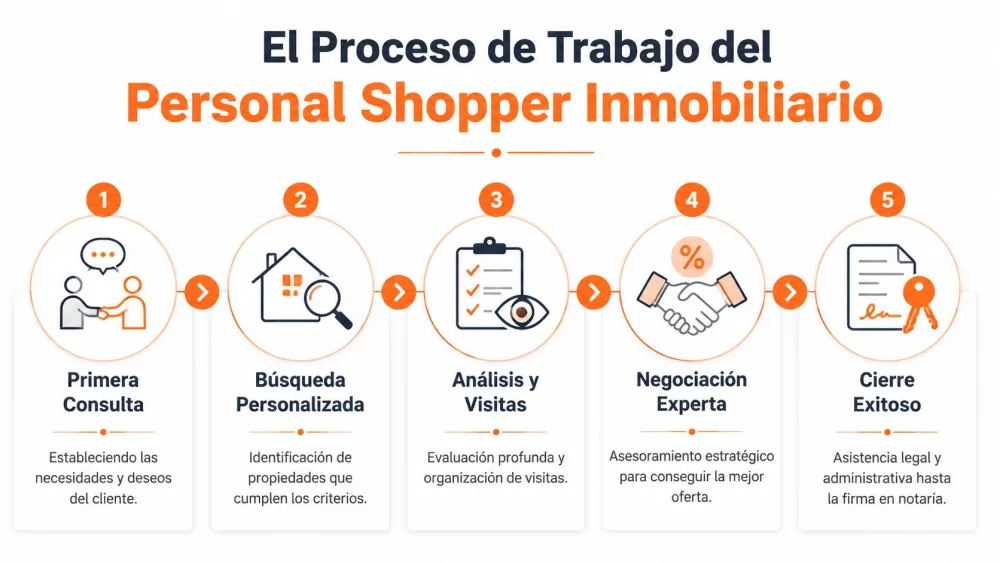
Initial consultation and defining the mandate
The first meeting isn’t to show properties. It’s to decide whether the client fits and whether the mandate is defined enough.
Clarify at least:
- Real budget and the buyer’s practical capacity.
- Area and intended use. Primary residence, replacement, investment or tactical purchase.
- Non-negotiable criteria and flexible criteria.
- Decision timeline and availability to move forward.
If this phase is done poorly, everything else becomes messy. The agent chases contradictory requests and the client feels “nothing fits.”
Search, filtering and useful presentation
Next comes active searching. This isn’t about forwarding listings. It’s about building a sieve.
For teams using CRM and automation, integrating prospecting and follow-up flows helps a lot. If your operations revolve around Keller Williams, it may be useful to review how to enhance sales prospecting with KW Command (https://www.salescaling.com/en/integrations/keller-williams-command) to organise tasks, follow-ups and communication with active clients.
Presentations to the buyer should be short and comparative: few options, well argued. Each property needs context, not just photos and square footage.
A complementary resource at this stage is seeing how other professionals use virtual tours for realtors (https://pedra.ai/blog/virtual-tours-for-realtors) when they want to reduce unproductive visits and improve pre-validation.
Technical analysis, documentation and viewings
This is where many pseudo-PSIs fall short. A quality service requires a multidisciplinary team, including a building surveyor for reports and a legal expert, because a single professional can’t master all aspects of a transaction. Also, according to Help to Buy in Madrid on characteristics of a good PSI (https://helptobuyinmadrid.com/caracteristicas-de-un-personal-shopper-inmobiliario/), lacking that coverage can expose the buyer to overpricing of 8–15%.
Work with a clear checklist:
- Real estate aspects. Price fit, comparables, future liquidity of the asset.
- Technical aspects. Property condition, visible defects, ITE, energy rating.
- Legal and registry aspects. Encumbrances, ownership, mortgages, cadastre status.
A good PSI doesn’t show a property without first asking whether it should be bought.
This video summarises the logic of accompaniment that today’s professional buyer expects:
Negotiation and closing
Negotiation starts before the offer. It begins when you choose which properties deserve deep analysis and which should be discarded.
In this phase, the PSI brings three things: market context, emotional management for the buyer and operational discipline. Then comes closing: deposit contract, coordination with lawyer, notary, final document checks and support through handover of keys.
If you want to turn this service into a stable business, document every step. What’s in your head doesn’t scale. What’s written does.
How to Structure and Charge for Your PSI Services
Charging appropriately for a personal shopper inmobiliario service depends less on the rate and more on how you explain it. If the client understands the process, the fee logic feels reasonable. If they don’t, any number will seem arbitrary.
Be direct. There is no single valid structure. What matters is that the model fits the client type, the complexity of the mandate and your operational capacity.
Three sensible ways to structure the service
Fixed fee
Works well when the mandate is clear and the search range is bounded. Its commercial advantage is strong: the client knows up front how much they’ll pay. In return, you must clearly define scope, exclusions and timelines.
Percentage of the purchase price
Easy for many clients to understand because it aligns the fee with the deal size. The risk is perception: if you don’t explain the value provided, it can look like you’re charging based on the property amount rather than the work.
Mixed model
Often the most balanced for many agents. Combines an initial commitment fee with a success-based portion. The upfront payment filters curious prospects and formalises the professional relationship. The final part rewards closing.
What your commercial proposal should include
Keep it simple, but put it in writing.
Include at least:
- Object of the service. What type of property you’re searching for and in which areas.
- Operational scope. Search, filtering, viewings, negotiation, document review, accompaniment to signing.
- Duration of the mandate. When it starts and under what conditions it’s reviewed.
- Whether exclusivity applies or not. This must be crystal clear.
- Payment terms. Initial payment, intermediate milestones and closing.
If the client doesn’t know exactly what they’re buying, they’ll argue about price. If they do, they’ll argue about fit.
How to set your price without improvising
Your fee shouldn’t come from “what competitors charge.” It should come from four variables:
| Variable | What you should assess |
|---|---|
| Complexity | Neighbourhoods, property type, real availability, difficulty of access |
| Operational intensity | Number of filters, viewings, coordination with third parties |
| Professional risk | Level of analysis required and perceived responsibility |
| Positioning | Whether you compete on volume or consultative service |
If you’re still designing your offer, review a structure of plans and margins before finalising your proposal. Pedra’s pricing page (https://pedra.ai/pricing) can help you think about how to package tools and service without blowing operational costs.
What works best when charging
What tends to work best in practice is asking for a reasonable initial commitment and leaving a main portion for closing. Not because it’s fashionable, but because it sets expectations. The client understands you started working from day one, and you avoid becoming a free searcher.
What doesn’t work is charging late, over-justifying or accepting ambiguous conditions. Once the service seems informal, the fee loses its strength.
Boost Your Service with Pedra Visual Presentations
There’s a blind spot across much of the personal shopper real estate market. Much is said about search, negotiation and paperwork, but very little about how selections are presented to clients so they can decide better and faster.
According to BCN Advisors on adding the personal shopper real estate role to sector services, most content about personal shopper services overlooks the impact of visual technology, even though these tools are a key differentiator for justifying premium fees and improving the client experience. That omission matters because in day-to-day practice it does make a difference.
What changes when you present better
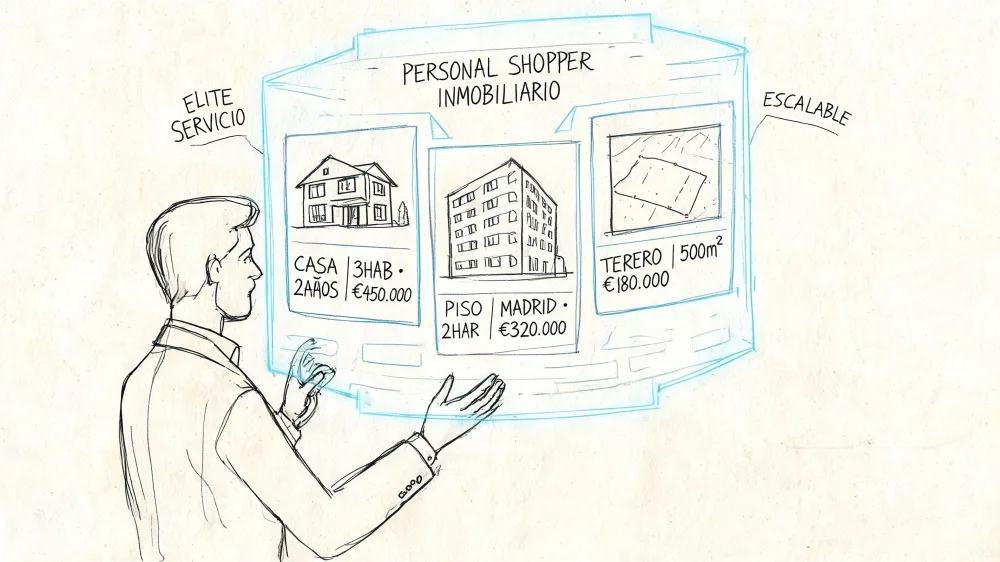
A professional buyer doesn’t need twenty links. They need a curated selection that’s easy to compare. That’s where a platform like Pedra comes in, enabling the creation of marketing-ready visual assets from photos or floor plans.
In the workflow of a personal shopper real estate service, that translates into concrete uses:
- Virtual staging to show the potential of an empty or outdated flat.
- Image enhancement to remove visual clutter and make comparisons clearer.
- Property videos to summarise visits and share options with decision-makers who weren’t present.
- 360° virtual tours for time-poor clients or international buyers.
- Visuals from floor plans when the buyer needs to imagine a future layout.
Why this improves your service margin
Visual presentation doesn’t replace the personal shopper’s judgement. It amplifies it. If the buyer understands an opportunity better, they decide sooner. So they have fewer redundant viewings, fewer repeated doubts and less bottlenecking in the selection phase.
It also changes how the service is perceived. A personal shopper who delivers analysis supported by well-crafted visuals communicates preparation, not improvisation. And when the client perceives preparation, they’re more willing to accept a premium positioning.
Finding a good option isn’t enough. You need to make it legible for the buyer.
Where Pedra fits best in the personal shopper workflow
Pedra is especially useful at three points:
- Before the viewing, to filter better and avoid pointless trips.
- After the viewing, to compare candidates with a coherent presentation.
- In complex transactions, when you need to show potential, renovation or repositioning of the property.
The agent who combines buyer-focused judgement, technical validation and visual storytelling will have a hard-to-replicate advantage. Not because they use a tool, but because they turn that tool into a clearer, more convincing buying experience.
If you want to make your personal shopper service more profitable, more organised and more persuasive for the client, it’s worth exploring Pedra. It lets you create enhanced images, virtual staging, videos, 360° tours and visuals from a single platform—without relying on multiple tools or slow processes. For an agent aiming to work better with demanding buyers, that can make a real difference in how they present, filter and close deals.