
A client calls you mid-morning. They have a job transfer, need quick cash, and tell you a company has promised them a cash offer in a few days. They’re not asking for a technical definition. They’re asking whether they should accept.
That moment sums up the iBuyer phenomenon in Spain. You’re no longer just competing with other agencies. You’re up against a very concrete promise: less friction, less uncertainty, and a short timeline. For some owners, that matters more than squeezing the last euro out of the sale price.
Many agents make the mistake of treating this model as a fad or an abstract threat. It isn’t. It’s a real alternative for a specific type of seller. If you understand it well, you can advise better, win listings earlier, and defend your value much more clearly.
The New Real Estate Challenge Is iBuyers
The scenario repeats more and more. An owner doesn’t want to prepare the property, doesn’t want visits, and doesn’t want to wait for the ideal buyer. They want certainty. If they’re also dealing with a separation, a complex inheritance, or a chained purchase, the conversation changes entirely.
In that context, iBuyers fit because they simplify a decision that is often emotional and heavy for the seller. They have grown their presence in Spain since the late 2010s and have focused mostly on major cities like Madrid, Barcelona, Valencia, Málaga, Sevilla, Zaragoza and Bilbao, according to Inmogesco’s analysis of the rise of iBuyers in Spain. Their offer is simple: they buy for cash, make offers within 24 hours, and can close deals in 7 days.
That forces agents to answer two questions more effectively. First: does that speed justify the discount? Second: is there a way to offer speed without giving away so much value? That’s the real commercial shift.
What the Client Is Really Buying
When a seller hears “we’ll buy your flat now,” they aren’t just buying quick money. They’re buying operational relief. Fewer calls, less negotiation, less exposure and lower risk of a deal falling through.
Practical rule: when the client prioritizes timeline and certainty, talking price alone isn’t enough. You must talk about friction.
Many agents still reply with a single argument: “you’ll get more on the open market.” That’s often true, but it doesn’t always win the conversation. If you don’t quantify time, effort and probability of closing, you lose relevance.
It’s also useful to read the market moment more broadly. The demand for speed doesn’t appear by chance. It’s connected to consumers who expect quicker processes in almost everything. If you want to follow that change with perspective, it’s worth reviewing these real estate market trends.
Where Your Advantage Begins
Your advantage isn’t denying iBuyers. It’s putting them in their place. They’re useful for certain cases, but they’re not the universal answer. A good agent knows when it makes sense to explore that route and when to set it aside quickly to avoid destroying value.
That professional filter is what makes you an advisor. Not an intermediary.
What an iBuyer Is and How It Makes Money
An iBuyer is a company that buys homes directly using a highly standardized process, data-backed valuation and a clear commercial promise: speed and certainty. For an agent, the label isn’t the point. The point is understanding their economic model, because that explains why some properties receive offers, why others are excluded, and why the final price rarely beats a well-executed open-market sale.
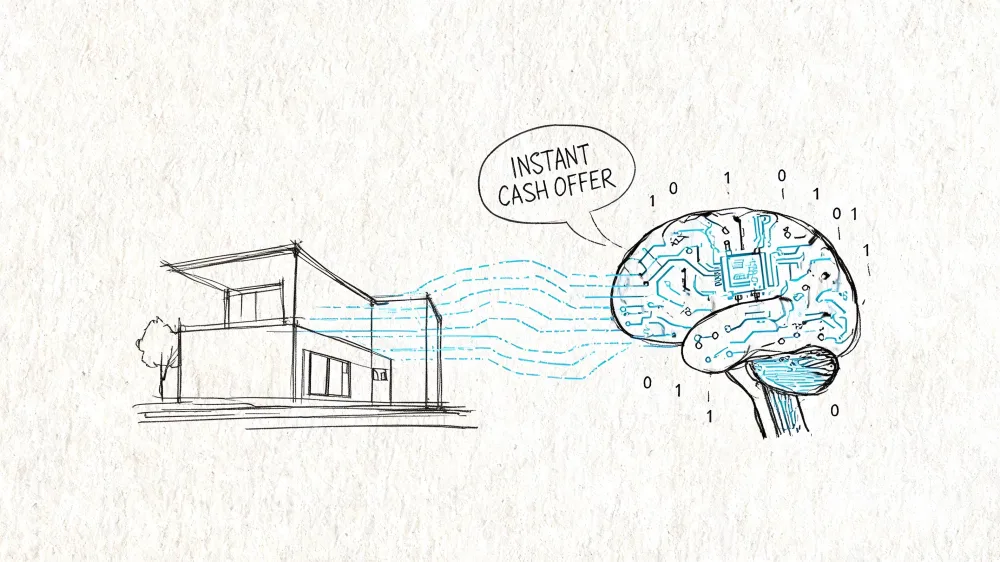
Their operational logic is simple. They select properties that are easy to value, easy to refurbish and easy to resell. The more predictable the asset, the better it fits the model. That’s why they focus on areas with sufficient comparables, a clear average ticket and active demand. If the property has quirks, needs major renovation or sits in a micro-market that’s hard to read, risk rises and the offer is adjusted or withdrawn.
How the real process works
From the outside it looks like an immediate purchase. In practice there are several filtering layers.
-
The owner requests an offer
They send basic property data, and sometimes photos, age, condition and encumbrances. -
The iBuyer calculates an initial valuation
They use automated models, recent comparables and internal risk rules to decide if the transaction fits their buying range. If you want to refine this professionally, it’s useful to master how a market-data-based real estate valuation works. -
They launch a conditional proposal
The quick offer is part of the product, but it’s rarely the final word. It’s often subject to document checks and a technical visit. -
They adjust for condition, issues and exit costs
Here the discounts the owner doesn’t always anticipate appear. Small defects, need for paintwork, carpentry, damp or title issues weigh heavily because the model needs certainty on cost and timing. -
They buy, refurbish and resell
The goal isn’t to hold the asset. The goal is to rotate inventory with margin and minimal time on the balance sheet.
Where their margin comes from
An iBuyer’s profit doesn’t rely on a single lever. It comes from buying below the resale value they expect to achieve, charging fees or implicit discounts for convenience, and tightly controlling refurbishment, financing and holding costs.
That detail changes the commercial conversation.
An iBuyer isn’t trying to win an emotional bidding war with the seller. They protect margin from minute one. If they detect uncertainty, they discount it in price. If they detect complexity, they walk away. That’s why the model rewards standard properties and penalizes operational friction.
What usually works and what usually fails
The model works best for flats with conventional layouts, reasonable condition, liquid locations and plenty of comparables. It also fits situations where the owner needs to close fast because of a move, inheritance, divorce or liquidity needs, and is willing to trade price for certainty.
It works worse for unique product.
Very special penthouses, homes needing full renovation, properties with encumbrances, assets in illiquid markets or listings with more aspirational than statistical demand usually perform poorly for iBuyers. In those cases the algorithm sees noise. The agent sees context, commercial narrative and repositioning opportunities.
That’s where a clear advantage appears for those who work the asset well. With visual tools like Pedra, an agent can present a potential renovation, shape buyer perception and better defend the value of homes an iBuyer would penalize for lack of standardisation. That difference isn’t cosmetic. It’s margin for the client and a commercial argument for the agent.
As an advisor, be straightforward about it. The iBuyer’s offer buys speed, reduces management and limits uncertainty for the seller. But that convenience has a cost, and that cost comes from a model that needs to buy cheap, fix fast and sell without surprises.
iBuyers vs Traditional Sale — A Key Comparison
The useful comparison isn’t “technology versus agency.” The useful comparison is certainty and speed versus potential maximum price. When you frame it that way, the client stops arguing in the abstract and starts deciding based on their real priority.
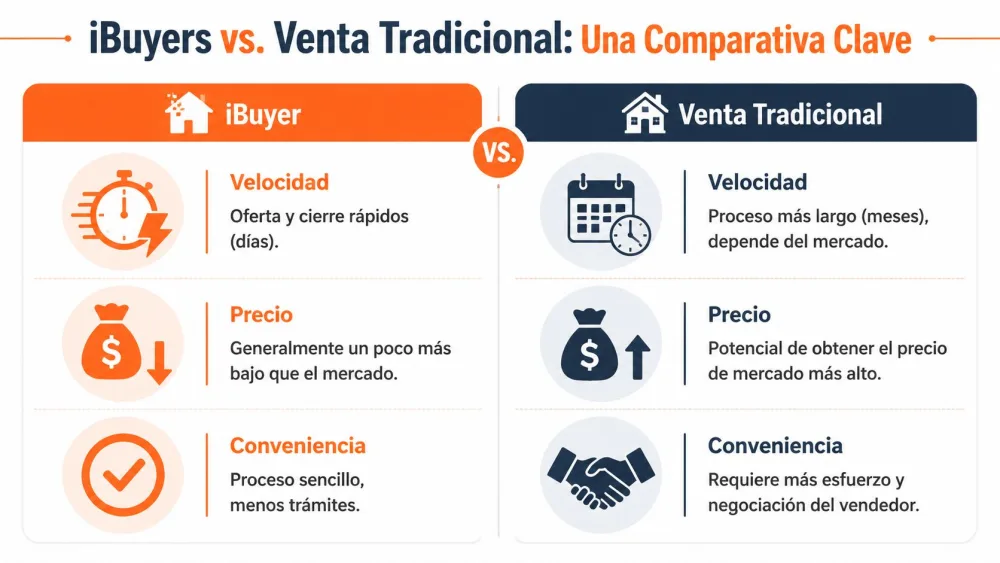
According to this explanation of how iBuyers and their offers work, iBuyers use automated valuation models that process thousands of transactions to generate offers in under 24 hours. That source indicates offers are typically between 8% and 12% below open-market price due to risk margins and a service fee of 5% to 7%. By contrast, a traditional sale can take 30 days or more to generate an offer but aims for the market’s top price.
The difference the seller actually feels
A traditional sale requires more work from the owner and the agent. There’s preparation, photography, visits, follow-up, negotiation and dependence on buyer financing. In return, the objective is to defend value.
The iBuyer removes many of those layers by reducing market exposure and buying at a discount. It doesn’t promise the best price. It promises a shorter, more controlled process.
| Criterio | Venta con iBuyer | Venta Tradicional (con Agente) |
|---|---|---|
| Velocidad | Oferta en menos de 24 horas y cierre rápido si el inmueble encaja | El proceso puede tardar 30 días o más en recibir una oferta |
| Precio | Oferta normalmente entre un 8% y un 12% por debajo del mercado abierto | Busca el precio máximo de mercado |
| Coste del proceso | Suele incorporar una tarifa de servicio del 5% al 7% | El coste depende del modelo de comercialización del agente |
| Visitas y exposición | Menos fricción, menos visitas, menos negociación abierta | Requiere gestión comercial, visitas y negociación |
| Certidumbre | Alta si la operación supera revisión e inspección | Depende del comprador, financiación y ejecución del proceso |
When to recommend one route or the other
Not all owners need the same thing. The right recommendation depends less on the tool and more on the context.
- Choose to explore iBuyer if the client needs quick liquidity, wants to avoid visits or cannot sustain a longer marketing process.
- Defend a traditional sale if the property has clear commercial potential and the seller can wait to capture a better price.
- Pause the decision if the owner has only heard “quick close” but doesn’t understand the total impact of the discount.
- Document comparables rigorously before giving an opinion. A solid pricing conversation starts with data, not intuition. To reinforce that work, it’s useful to review how to approach real estate pricing methodically.
The most common commercial mistake
Many agents respond to the iBuyer with an empty promise of “I’ll get you more.” That’s not enough. What convinces is detailing the strategic difference.
If your offer competes only in rhetoric, the iBuyer wins by simplicity. If your offer combines price, an exit plan and control of the process, you regain advantage.
Key point: the iBuyer sells packaged speed. The agent must sell packaged judgement.
The Real Reach of iBuyers in the Spanish Market
The noise around iBuyers can make it seem like they’ll buy almost anything. That’s not true. Their real reach in Spain is much narrower than many owners believe.
According to this analysis of property fit for the iBuyer model, in Spain iBuyers limit operations to “standard” properties, especially flats between 60 and 120 m² with values from €150,000 to €450,000, covering only 22% of the national stock. Their algorithms also reject up to 65% of requests when the asset isn’t “AVM-friendly,” for example because it’s in rural areas or has non-uniform conditions.
The type of property that interests them
Their natural terrain is urban flats that are relatively homogeneous and easy to compare. They prefer properties with clear data, liquid location and predictable exit.
That leaves out many types of homes that a good agent can sell. Unique properties, homes requiring full renovation, rural product, properties with atypical layouts or assets where the emotional component outweighs comparable logic are often excluded.
The point where the offer can move
Another important commercial detail is that the initial figure doesn’t always survive intact. The same reference notes that an in-person inspection can reduce the initial offer by between 2% and 15% if undisclosed discrepancies appear.
That changes completely how you should advise the seller.
- If the property has visible defects, prepare the conversation about adjustments before the owner anchors to the first number.
- If the home is non-standard, don’t sell the idea of “it will surely fit.” Be honest that the algorithm may exclude it.
- If the client arrives excited about an online offer, explain that it’s not yet the final contract price.
The agent who knows the iBuyer’s operational limits stops seeing them as total competition. They start seeing them as a niche buyer.
Where the opportunity to win listings is
Many properties don’t fit that industrial logic. That’s where the agent’s work adds the most value. When you need to narrate potential, plan a renovation, reposition a property or build buyer perception, the algorithm loses strength and human judgement matters far more.
In other words, the less standard the asset, the more important your work becomes.
How to Use Pedra to Compete and Collaborate with iBuyers
The most interesting effect of iBuyers isn’t that they buy lots of homes. It’s that they have accustomed owners to expect speed. That expectation is now in the market, and the agent who wants to remain competitive must respond with faster processes and much stronger visual presentation.
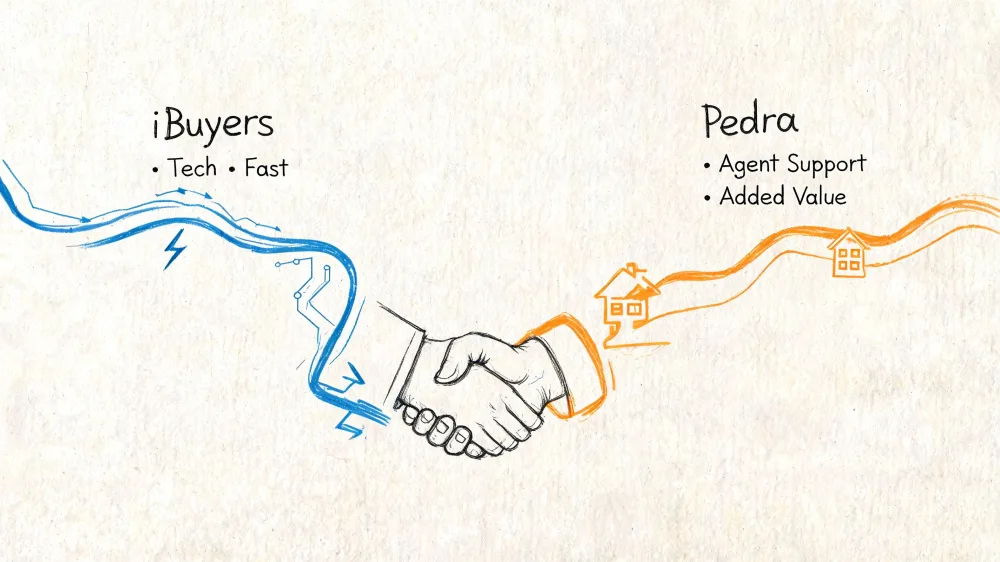
According to Kiplinger, iBuyers accounted for less than 0.5% of purchases in the U.S. in 2023 and only 0.2% in Spain in 2025, but their existence creates a demand for speed. The same reference points out that 70% of buyers decide based on photos and that improving visual quality with virtual staging and 360° tours can increase a listing’s visibility by 30%, allowing you to compete without absorbing the 8%–10% discount iBuyers apply.
Competing with the iBuyer model
If your client doesn’t need a liquidation-style sale, you can use visual AI to offer a fast experience without giving up the open market. The key isn’t to mimic the iBuyer on price. The key is to match their perceived speed.
An effective workflow usually includes these elements:
-
Enhanced photos from day one
If the listing goes live poorly presented, you lose initial momentum. Fixing light, perspective and visual quality accelerates market entry with a more professional image. -
Virtual staging for empty properties
An empty flat forces buyers to imagine. Many don’t. Digitally furnishing helps translate square footage into realistic use. -
Virtual renovation for dated properties
Old kitchens, tired bathrooms or dark living rooms often trigger objections before a visit exists. Showing a renovated version frames the conversation and reduces mental friction. -
Property video and 360° tour
If you need to concentrate interest fast, these assets do two things at once: they filter buyers more efficiently and provide a fuller initial visit.
Collaborating when the client does want an iBuyer offer
You won’t always be competing. Sometimes the client has already decided to explore that option. Even then you can improve the result by presenting the asset better before requesting the offer.
The logic is simple. If the iBuyer values data and visual signals, a clearer presentation can reduce negative readings about condition or potential.
What to prepare before asking for the offer
-
Choose clean, consistent photos
Avoid dark, crooked or cluttered images. Poor visual representation can penalise perception even before inspection. -
Add an optimized version of the space
If a room is empty or poorly used, show a more functional interpretation. -
Produce contextual materials
A clear floor plan, a coherent visual walkthrough and an organised presentation reduce ambiguity. -
Align expectation with reality
If there are relevant defects, it’s better to disclose them than let them appear as surprises during review.
Operational tip: use visual presentation not to hide problems, but to prevent the property from looking worse than it is.
What works and what doesn’t
It works to turn a “normal” flat into a product that’s easy to understand. It works to clearly show layout, potential and condition. It works to go to market with all assets ready from day one.
It doesn’t work to rely on unbelievable images or promise a transformation that visits then contradict. Nor does a great visual replace correct pricing. Visuals speed up and improve perception. They don’t fix bad positioning.
The commercial advantage for the agent
Visual AI changes something concrete. It reduces time between listing and market launch, and improves the quality of the first impact. That lets you respond better to the anxiety of the modern seller, who compares any process with an instant offer.
If you want to go deeper on applying this approach to listing acquisition, presentation and marketing, it’s worth reading these ideas about AI for real estate agents.
The Future of iBuyers and Key Questions for Agents
iBuyers don't look set to dominate the Spanish market. Nor will they disappear from sellers' minds. They've created an expectation: "I want to know quickly what my exit is worth and how long it will take to close."

According to Curbio and the cited data on the model’s recent evolution, in 2025–2026 Spanish iBuyers were purchasing about 450 homes per month, with 40% of their inventory unsold after 6 months. The same source notes rejection rates reaching 65% in regions like Andalusia and that hybrid agent–iBuyer models grew 20% in Madrid in 2026. It also points out that offsetting discounts near 12% is becoming key to staying competitive.
Questions an agent should be able to answer
Will they replace agents?
That seems unlikely. Their operations are designed for a specific niche of assets and sellers. When a property falls outside the typical pattern or the transaction requires guided support, nuanced negotiation and emotional management, the agent remains central.
What is the biggest risk for the seller?
The later reduction in the offer. Owners can fall in love with an initial figure and later discover the real deal changes once a deeper property review takes place.
Does it make sense to collaborate with this model?
Yes—if you use it as one option in your toolkit. A strong advisor doesn’t push a single exit strategy. They advocate for the right exit for each case.
Where the market is heading
The interesting point is in hybrid models. Clients want human guidance, but they also want speed, clarity and less operational hassle. That combination favors agents who integrate technology without surrendering strategic control of the sale.
That includes three very concrete habits:
-
Respond faster
If you take days to land a strategy, the owner will look for a quicker alternative. -
Present better
In a market flooded with weak listings, visual quality stops being merely aesthetic. It becomes a sales tactic. -
Advise with options
A strong agent doesn’t say “this won’t work.” They say “this route works for this profile, but these are the consequences.”
The future won’t be agent versus algorithm. It will be the slow agent versus the agent who uses technology better.
Practical conclusion
Your work doesn’t lose value because an instant buyer exists. Your work gains value when you can translate speed, price, risk and presentation into a useful recommendation.
The owner doesn’t just need an exit. They need to understand which exit suits them best. That’s where the good agent’s space remains.
If you want to respond to iBuyers’ pressure without entering a discount war, Pedra helps you prepare enhanced photos, virtual staging, videos, 360° tours and visual assets ready to market a property in minutes. It’s a practical way to go to market sooner, present each listing better and defend the value of your listings with much faster execution.