
Digital Real Estate Agency: A 2026 Guide to Transforming Your Brokerage
Run a digital real estate agency that closes faster: tools, automation, visual presentation and a step-by-step plan for real estate digital transformation.
Many agency owners are facing the same problem. The phone keeps ringing, contacts come in via WhatsApp, Idealista, social media and referrals, but the day is swallowed by replying to messages, asking owners for photos, coordinating viewings, fixing listings and chasing clients who cool off quickly.
Meanwhile, another agency in your area publishes first, replies faster and presents each property better. Not necessarily because they have more experience — often they simply work with a more orderly system.
This is the breaking point. The digital real estate agency isn’t born because the traditional office stopped working. It’s born because the client now expects greater speed, clearer communication and a different experience. If your process depends on scattered spreadsheets, photos sent by phone and manual follow-up, you’re competing with a backpack full of repetitive tasks.
The good news is the transition doesn’t require tearing your business down and starting from scratch. It requires redesigning how you source listings, how you follow up and how you present the product. Technology doesn’t replace the agent’s commercial judgement. It frees them to use it where it really adds value: filtering better, advising better and closing better.
The Starting Point for the Modern Real Estate Agent
María runs a family agency. She has been selling well in her area for years. She knows the owners, understands which streets move faster and can tell quickly when a buyer is serious. But her team spends their days putting out fires. One salesperson asks an owner for photos and waits days for them. Another rewrites a listing because square footage, orientation or a presentable image are missing. The coordinator tries to remember who requested a second viewing and who wanted financing.
The problem isn’t a lack of effort. It’s too much manual work.
When an agency operates like this, each transaction depends too much on team memory. If someone is absent, follow-ups get lost. If volume increases, service quality drops. And if a competitor presents a property better and faster, the owner begins to wonder whether they’re with the right agency.
Practical rule: if a task repeats in nearly every listing, it shouldn’t rely on improvisation.
Many agents think digitalising means opening more social media accounts or redesigning the website. That helps, but it doesn’t solve the main bottleneck. Real transformation starts when you stop working by impulse and start working by process.
The real change isn’t technical
A traditional agency tends to operate reactively. An opportunity arrives and the team scrambles. A digital real estate agency works more predictably. It defines what happens from the moment a lead enters until a reservation is signed. It decides which tool stores the information, who responds, how quickly and with what commercial material.
That mindset shift matters more than any software. Because technology organises, but first you must decide what you want to organise.
Signs you already need to change
There are several clear symptoms:
- Follow-up scattered: contacts spread across phone, email, incomplete CRM and internal notes.
- Slow marketing: each property requires too many back-and-forths before it’s ready to go live.
- Dependence on specific people: if one salesperson doesn’t respond, nobody knows exactly what stage the client is at.
- Hard to measure: you know you’re working hard, but you don’t clearly see which channel brings the best opportunities.
The modern agent isn’t the one who uses the most tools. It’s the one who achieves a cleaner, more visible and more measurable operation.
What a Digital Real Estate Agency Really Is
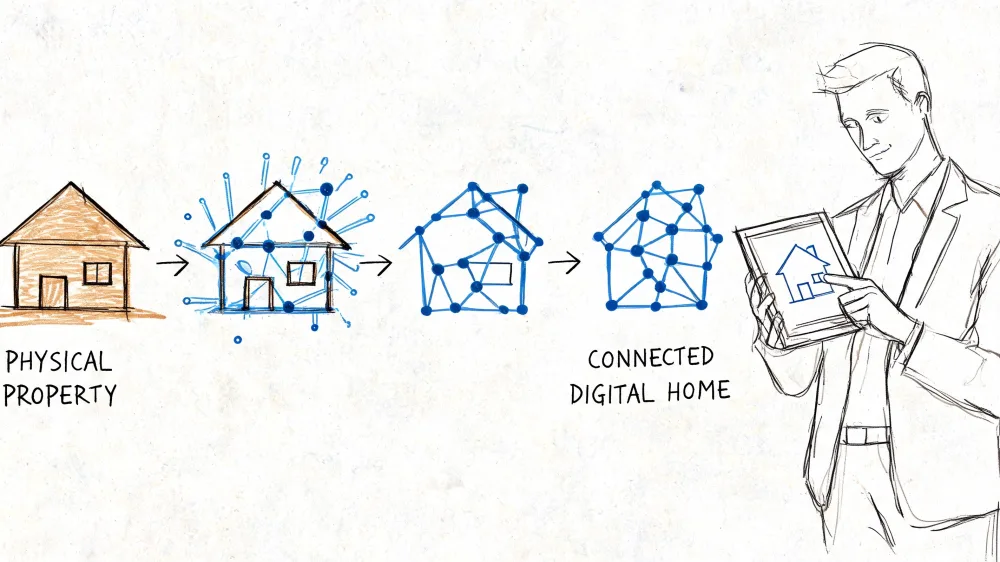
A digital real estate agency isn’t an agency with a website and an Instagram profile. It’s an agency that turns its operations into a connected system. Data aren’t scattered. Communication doesn’t rely on memory. Property presentation isn’t improvised each time.
In Spain, the context is already pushing in that direction. In the first quarter of 2025, the Spanish real estate market reached the highest level of transactions since 2007, according to the registral real estate statistics for Q1 2025. When the market moves with that intensity, presenting better and reacting sooner stops being a detail.
The comparison that explains it best
Think of a local corner shop and a large e-commerce retailer.
The corner shop can work very well due to proximity, trust and customer knowledge. But many decisions depend on the person serving, visible stock and non-automated processes. A large digital retailer, by contrast, connects inventory, support, recommendations, follow-up and logistics in a single circuit.
The same happens with real estate.
The traditional agency relies more on the individual agent. The digital agency turns that knowledge into a system. If a lead arrives, it’s recorded. If they request a viewing, a flow is triggered. If a property needs better presentation, the team knows how to produce it without reinventing the process.
The three pillars that support it
Data-driven operations
Each property, each lead and each owner generate useful information. A digital agency stores this in a central environment. That makes it possible to see which listings convert better, which property types take longer to sell and which salesperson needs support on follow-up.
You don’t need to talk about big data to apply this. It’s enough that the data don’t live in different places.
Omnichannel client experience
Clients no longer distinguish between channels. They may discover a flat on a portal, message via Instagram, ask for details on WhatsApp and want a virtual viewing before travelling. For them, it’s all part of one experience.
If the agency responds with different messages, different timings and disorganised materials, it creates friction. If it responds consistently, it conveys control.
A digital real estate agency doesn’t just sell square footage. It sells clarity throughout the process.
Process automation
Automation doesn’t mean dehumanisation. It means the team doesn’t waste time on predictable tasks. Confirmations, lead assignment, preparation of visual assets, status updates and information dispatch can follow a defined logic.
That frees the agent for the most delicate parts of the job: listening to objections, valuing a property, negotiating an offer and supporting a major decision.
Benefits and Digital Business Models
There isn’t a single model of digital real estate agency. Transformation can take different forms depending on the agency’s size, its area and the type of clients it serves. What matters is choosing an operational model that’s coherent, not copying random tools.
The hybrid model
This is the most realistic for many traditional agencies. It keeps local presence and human relationships, but digitises follow-up, marketing and property presentation. The agent continues visiting properties and closing meetings, but works with clearer processes and less dependence on manual tasks.
This model usually works well when the agency already has a reputation in an area and doesn’t want to lose proximity.
The fully digital agency
Here almost the entire operation relies on remote channels. Sourcing, support, filtering, documentation and initial viewings go through digital systems. The physical office ceases to be the business hub.
Its advantage isn’t only operational savings. It also allows serving a wider geographic market and organising teams with more specialised functions.
Service platforms for agents
There’s another, less visible route. Some companies don’t operate as agencies for end clients but as a technology layer for agencies and agents. They provide CRM, automation, visual production, publishing or analytics.
For a small or medium agency, this model is useful because it avoids building internal capabilities from scratch. Instead of creating a full department, you lean on specialised tools.
Concrete benefits
On the commercial side, personalisation already shows a clear impact. AI applied to digital real estate in Spain achieves 95% accuracy in valuations and increases lead conversion by 30% by personalising searches, according to the analysis published by Maginmuebles on technology in real estate agencies.
That helps explain why the digital approach isn’t a trend. It has direct operational effects.
| Model | What it preserves | What it digitises more | Best fit |
|---|---|---|---|
| Hybrid | Local relationships and in-person viewings | Follow-up, marketing and management | Established agencies in a specific area |
| Fully digital | Lightweight structure | Almost the entire commercial cycle | Teams prioritising scale and speed |
| Service platform | Agent’s or agency’s own brand | Specific capabilities delivered as modules | Businesses that want to advance without building everything internally |
The time you recover is valuable
When an agency automates repetitive tasks, the most visible benefit isn’t always financial at first. Often it’s organisational. The team stops chasing information and starts making decisions with more context.
This changes the workday:
- Less manual administration: less copy-and-paste between systems.
- More commercial focus: more time to filter buyers and handle objections.
- Better consistency: properties hit the market with a uniform standard.
- Greater responsiveness: the client receives information without waiting for someone to “find” the data.
The agent doesn’t lose prominence by digitalising. They lose low-value tasks.
The Essential Tech Ecosystem for Your Agency
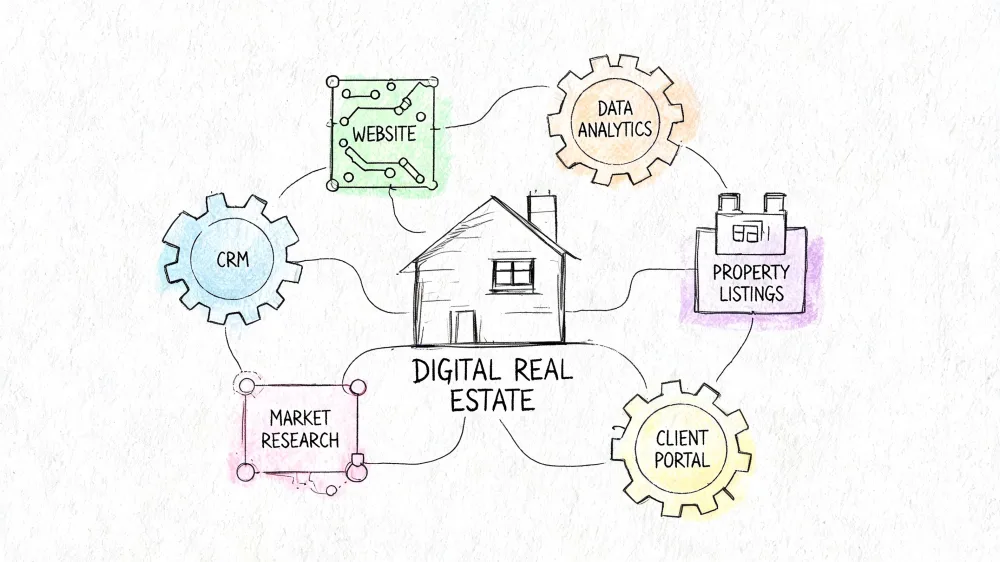
An agency doesn’t digitalise by buying a standalone tool. It digitalises when several pieces fit together. If the CRM doesn’t talk to your acquisition channels, if marketing actions don’t feed follow-up and if visual production goes its own way, you’ll keep working in fits and starts.
Client and operations management
The first block is the real estate CRM. This is where the lead, owner, property and transaction records live. It’s where the team sees what’s happened, what’s missing and who’s responsible for the next step.
If your agency still depends on spreadsheets, a CRM isn’t a luxury. It’s the point where the business stops depending on each person’s memory.
At minimum it should offer:
- Centralised registration: each lead enters with an identifiable source.
- Visible history: calls, viewings, messages and status changes.
- Clear assignment: who owns each contact.
- Tasks and alerts: so follow-up isn’t lost.
Marketing and sourcing
The second block brings together the website, portals, social channels, email marketing and content. Here many agencies get confused. They publish a lot, but measure little. Or they generate leads, but the handover to the sales team is weak.
The right logic is simpler. Each channel should serve a function.
| Area | Main function | Common mistake |
|---|---|---|
| Real estate website | Capture demand and reinforce trust | Letting it fall out of date |
| Portals | Provide immediate visibility for stock | Publishing with weak visual assets |
| Social media | Generate local awareness and recognition | Talking only about properties |
| Email and automation | Nurture leads and reactivate interest | Sending the same message to everyone |
Visual presentation of properties
This block is often underestimated and, at the same time, one of the most visible to clients. Real estate photography, property videos, floor plans and virtual tours aren’t ornaments. They’re part of the sales process.
In Spain, virtual viewings reduce operating costs by 60–70%, increase initial conversions by 50% and in some digital agencies 80% of transactions start with a virtual tour, according to the analysis on the impact of virtual reality in the real estate industry.
That explains why the visual layer can no longer be handled in a purely artisanal way.
Where a visual platform fits
This is where a tool like Pedra for real estate agents comes in. Its role is to centralise visual production in a single workflow: photo enhancement, virtual staging, property videos, 360° tours and marketing assets generated from images or floor plans. For an agency, this avoids relying on several different suppliers for each asset.
Your whole team doesn’t need to be technical. What’s needed is a repeatable method to turn a new listing into a visually competitive real estate listing.
If a property enters the market well presented, the salesperson starts the conversation with an advantage.
The most common mistake when building the stack
Many agencies buy tools on impulse. They watch a demo, activate a subscription and expect the team to adopt it on its own. Later they say the technology doesn’t work.
What doesn’t work is a collection of apps without process.
A useful ecosystem starts with a practical question: what must happen from the moment I take a listing to when a qualified buyer requests a viewing? If you can map that journey, you already know which technology you need and which is unnecessary.
Roadmap for the Digital Transformation of Your Agency
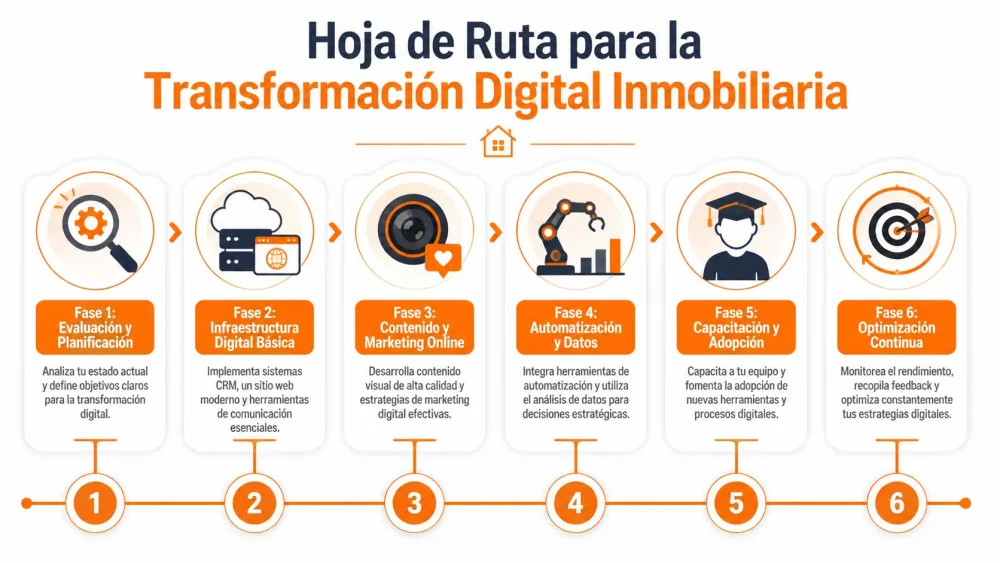
Transformation works best when executed in phases. If you try to change tools, processes, roles and marketing all at once, the team freezes. When each step has an owner and clear controls, adoption is much smoother.
When you do this, the commercial context matters. In 2025, home sales in Spain grew 4.4%, the average price per square metre rose 7.5% and purchases by foreigners declined, according to the evolution of home sales from the Notary. In a market like that, visual assets and commercial speed matter more because the buyer is more selective.
Here’s the visual sequence of change:
Phase 1 — 30 days
Start with diagnosis and priorities. Don’t buy anything yet.
Review how a lead arrives, how it’s assigned, how long responses take, how a property is published and where opportunities are lost. Speak separately with sales, coordination and management. Each group usually spots different bottlenecks.
Define three things:
- A commercial objective: for example, reduce time-to-market.
- An operational objective: centralise follow-up.
- A marketing objective: raise the visual quality of listings.
The critical role here is the digital transformation leader. They don’t need to be technical. They must understand operations, coordinate decisions and prevent each salesperson from inventing their own system.
Phase 2 — 60 days
Now implement. Order matters. CRM and the commercial flow come first. Then basic automations. Then the visual production and publishing system.
Training must be very practical. No generic “innovation” sessions. Teach real tasks: how to record a lead, how to change statuses, how to prepare materials for a listing and how to reuse assets on social channels or portals.
It’s also worth documenting a minimum protocol. If a property is taken, what photos are required? Who validates the material? Who publishes? What message does the first interested buyer receive? A digital agency reduces operational doubts.
To strengthen dissemination, review how social media automation for real estate works, especially if your team posts irregularly and without a calendar. It also helps to revisit your broader real estate marketing plan so each channel pulls in the same direction.
Operational tip: don’t measure adoption by team enthusiasm. Measure it by real use and weekly consistency.
Phase 3 — 90 days onward
From here the agency stops “installing tools” and starts improving. You can already see which channel brings higher-quality leads, which properties need better presentation and where demand drops out of the funnel.
The work changes in nature. Less implementation, more continuous improvement.
A monthly review typically includes:
- Sales funnel: lead source, response time, viewing and closing.
- Stock quality: whether visual presentation meets the agreed standard.
- Salesperson performance: follow-up and conversion.
- Client friction points: dead time, confusing messages or duplicates.
This video summarises the logic of that transition well:
The KPIs that actually make sense
You don’t need to obsess over data. You need a few useful indicators.
| Phase | Duration | Key actions | KPIs to measure |
|---|---|---|---|
| Diagnosis | 30 days | Process audit, tool map, objective definition | Lead response time, time-to-publication, current system usage |
| Implementation | 60 days | CRM, basic automation, commercial protocol, training | % of leads registered, task completion rate, publication consistency |
| Optimization | 90+ days | Funnel review, marketing adjustments, flow improvements | Lead conversion rate, time-to-sale per property, customer acquisition cost |
The roles you really need
In a small agency one person can take on several functions. Still, it helps to separate responsibilities.
- Direction: sets priorities and prevents the project from becoming “we’ll see”.
- Transformation leader: coordinates implementation, training and follow-up.
- Sales team: uses the CRM disciplinedly and provides field feedback.
- Marketing or coordination manager: ensures every property goes out with consistent materials.
When each role knows its responsibilities, digitalisation stops feeling like extra work and starts to look like a better way to work.
The Future of Real Estate Is Visual and Automated
The future of the industry doesn’t belong to the agency with the most tools. It belongs to the agency that delivers clear operations, compelling presentation, and a seamless experience for both buyer and seller.
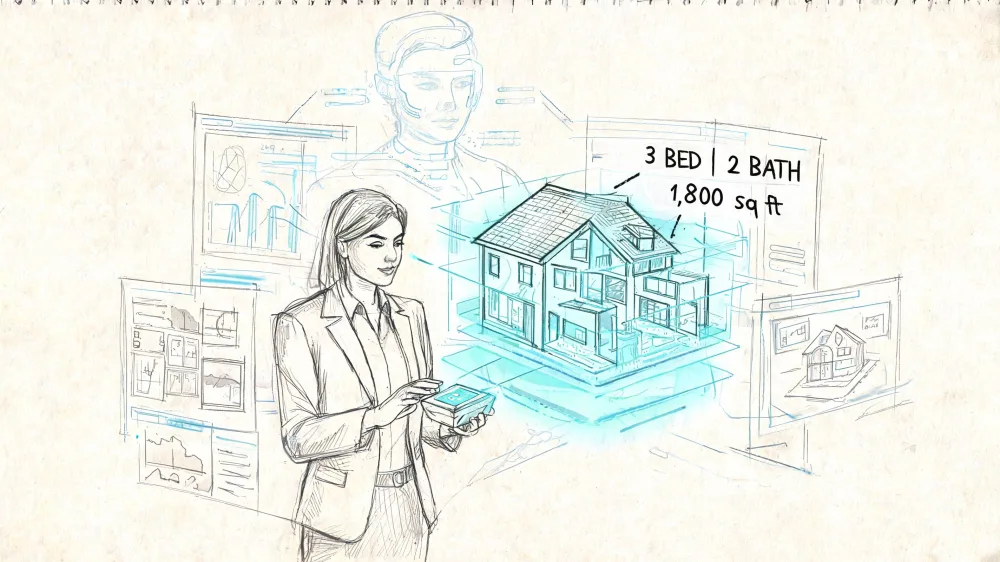
The real estate agent remains central. But the role shifts. They move from handling scattered tasks to acting as an advisor who interprets information, guides decisions, and inspires confidence. Technology takes on repetitive work. The agent regains time for what clients truly value.
Visuals are no longer optional
It used to be enough to “have photos.” Not anymore. Buyers compare properties long before they visit. The first impression happens on a screen, not at the front door. That’s why virtual staging, videos, tours, and richer presentations are on the rise.
If you want a broader perspective on how these formats are changing, it’s worth reading the future of photography, which connects visual evolution with today’s real estate experience.
Digital transformation doesn’t end when you buy software. It ends when your agency can operate better, measure better, and present every listing better.
It’s also worth watching how immersive viewings evolve and affect the sales process. This guide on virtual tours for real estate agents helps ground that change from a practical point of view.
The agency that adapts won’t be the most futuristic. It will be the most useful to its clients. And that usefulness today is built with simple processes, organized data, and visual presentation that meets the expectations of much more demanding buyers.
If you want to take that first step without complicating operations, Pedra can help you turn photos or floor plans into marketing-ready visual materials — AI virtual staging, enhanced images, property videos, renders and virtual tours — within a more organized workflow for your agency.

Related Posts
How to Market a Real Estate Listing: The 6 Things a Professional Listing Needs
The six assets a professional real estate listing needs — photos, video, virtual tour, floor plan, s...
Best AI Video Tools for Real Estate Agents (2026): Tested and Compared
Nine AI video tools compared for real estate work, with current prices and the one distinction most ...
Best Virtual Staging Software (2026): Seven Tools Compared on Cost Per Listing
Seven virtual staging tools compared with current prices, priced the way you actually buy — per list...
BoxBrownie Virtual Staging Pricing (2026): What It Really Costs Per Image
BoxBrownie charges €30 per image for virtual staging with under-48-hour turnaround. Here's the full ...
Listing Presentation Templates: Win More Clients
Professional listing presentation templates that close deals. Customizable CMA templates, market ana...
Win More Deals with Your Real Estate Listing Presentation
Master your real estate listing presentation to attract clients and close more deals. Learn expert t...