
WhatsApp for Real Estate: Agent's Guide to More Listings (2026)
WhatsApp for real estate done right. Set up Business, send messages owners actually answer and turn chats into property listings — scripts and tactics inside.
It happens every day. You see owners who could fit your portfolio, you save their contact, you think about messaging them and then put it off because you don’t want to sound invasive, generic or desperate. When you finally send a message, it sounds like every other agent’s: plain text, no context and no clear reason to reply.
That’s where WhatsApp can become either a client-acquisition tool or a chance-burning machine. The difference isn’t “having WhatsApp Business.” It’s in how you organize the contact, how you present value from the very first message, and how you use visual formats so the owner perceives professionalism before meeting you.
I’ve seen the same pattern with many agents. Those who improvise end up chasing replies. Those who use a system get real conversations. And today, to acquire properties via WhatsApp, the system can’t rely on text alone. If your competition sends “Hi, have you thought about selling?” you need to send something that makes the owner stop, open and reply.
Prepare Your Work Tool: Optimize Your WhatsApp Business Profile
An owner decides in seconds whether your message is worth attention or goes straight to the archive. Before writing a single line, your profile must convey order, specialization and trust. Initial setup is not a detail. According to Idealista on how to acquire properties via WhatsApp, optimizing your profile with a corporate photo, service description, address and hours increases perceived professionalism by 40%.
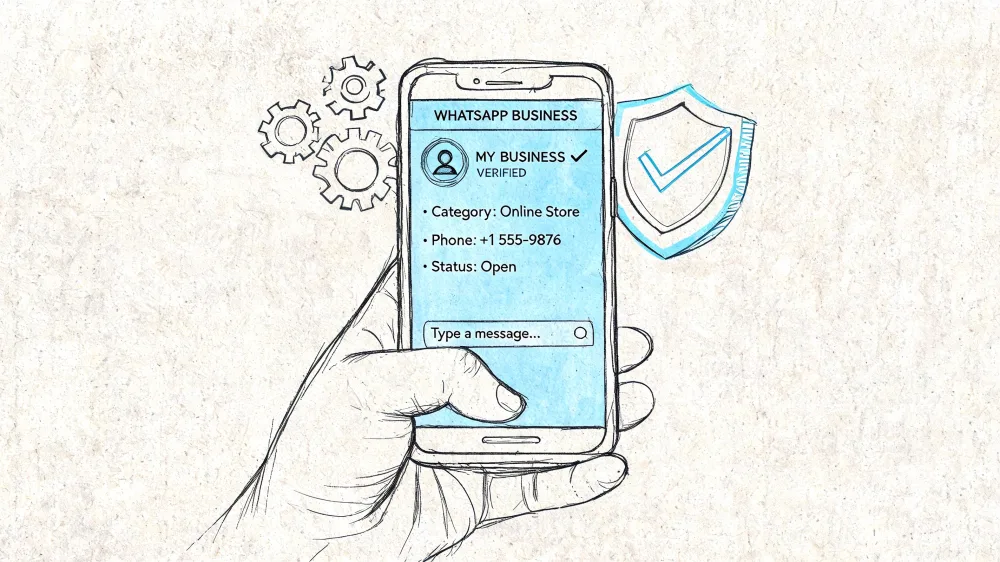
The minimum your profile should have
Don’t use a cropped vacation photo or a low-res logo. If you work on personal brand, a professional headshot works well. If you operate under an agency with strong visual identity, use the logo only if it remains clear and recognizable at small size.
Quick checklist:
- Clear photo: visible face or legible logo.
- Consistent trade name: your name + area or brand.
- Useful description: no “comprehensive advisor.” Say what you do and where.
- Address and hours: reduce friction.
- Email and website if you have them: reinforce credibility.
A good description doesn’t sell smoke. It directs. For example: “Home valuations and sales strategy in Chamartín, Tetuán and Salamanca.” It’s specific. It sounds like specialization, not a template.
The catalog also attracts
Many agents ignore the catalog because they think it’s only for e-commerce. Wrong. In real estate you can use it as a small services dossier.
Include items like:
- Free valuation: explain what the owner receives.
- Marketing plan: photos, distribution channels, filtered viewings.
- Examples of similar properties: without invented figures or promises.
- Visual presentation materials: if you already use videos, tours or visual comparisons, this is their place.
Practical rule: if your profile looks like a makeshift freelancer’s, your messages read with distrust. If it looks like an organized professional’s, the same message carries weight.
Automate the basics without sounding robotic
Automated messages don’t replace conversation. They prepare it. The welcome message should open a door, not drop a commercial brick. The away message should keep a human tone.
Useful examples:
“Thanks for writing. If you’re thinking of selling or valuing your home, I can advise you based on your area and property type.”
“I’m currently unavailable but will reply as soon as I’m back. If you want, send me the property’s neighbourhood and I’ll get back with an initial orientation.”
Also, use labels from day one. Don’t leave it for “when I have more contacts.” If you don’t label early, you’ll work blind later. Simple labels like “owner,” “valuation pending,” “follow-up” or “cold” already save a lot of chaos.
Contact Strategy: Where to Find and How to Segment Owners
The problem is rarely lack of contacts. It’s usually lack of criteria to decide whom to message first and with what approach. If you put everyone in the same bucket, you end up sending generic messages and wasting time on people who aren’t at the right moment.
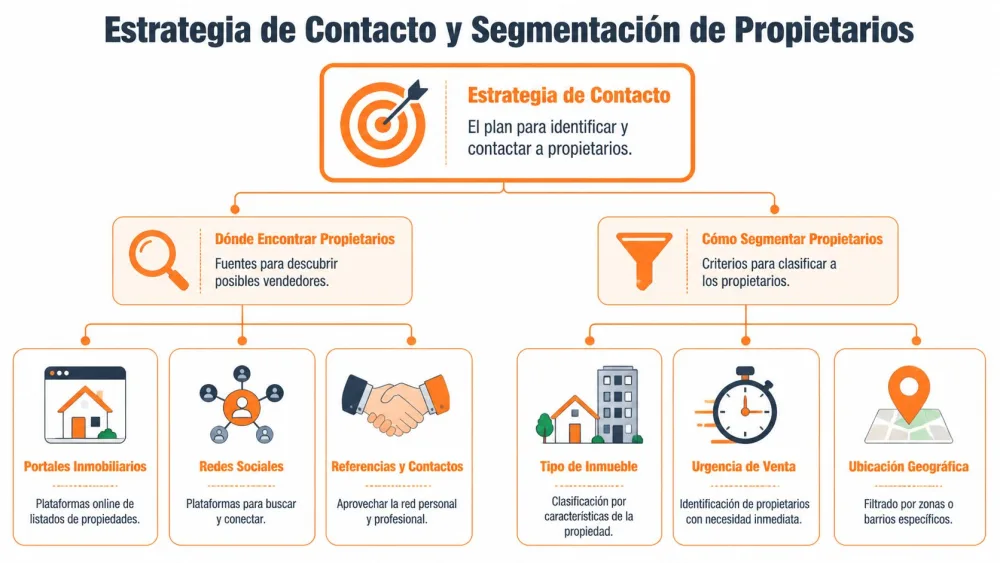
Where to find useful contacts
You don’t need to become a number hunter. You need to work legitimate, relevant sources.
Most practical ones:
-
Leads from your database
Owners who asked for information, a valuation or spoke with you months ago. Many weren’t ready then but may be now. -
Local networking contacts
Property managers, shopkeepers, recommending neighbours, past buyers, concierges and local professionals. They may not give a direct listing but they provide context and door-openers. -
Owners who arrive via recommendation
Among the best WhatsApp contacts because the trust framework already exists. Here the message can be more direct and natural. -
Inbound enquiries from other channels
Forms, social, missed calls, ads and portals. If the owner already initiated contact, WhatsApp helps continue without friction.
If you want to complement acquisition with less invasive channels, this guide on how to get real estate clients without cold calling has good ideas to fill the funnel before moving to chat: How to Get Real Estate Clients Without Cold Calling
How to segment usefully inside WhatsApp
According to Inmovilla on strategies to acquire properties via WhatsApp, segmenting your database by location, property type and urgency is key for ROI, and personalizing the first message with relevant data outperforms generic messages.
You don’t need a complex system. You need one you actually use.
Try a structure like this:
| Label | Purpose | Example |
|---|---|---|
| Area | Quickly place the market | Chamberí, Gràcia, Nervión |
| Type | Tailor the argument | apartment, detached house, penthouse, rental |
| Timing | Gauge readiness | immediate, considering, future |
| Action | Know next step | call, send valuation, follow-up |
A simple system that you will maintain
What works day-to-day is combining a few clear labels. For example:
- Concrete area: don’t put “Madrid.” Put the neighbourhood or micro-area.
- Property type: renovated flat, flat to renovate, detached house.
- Detected intention: selling soon, comparing options, inheritance.
- Next action: send analysis, schedule call, review in a week.
A contact without a label is a contact you’ll read from scratch next time.
When someone replies, update the label immediately. It’s seconds of work that prevent errors like resending the same message to someone who already told you they don’t want to sell.
The Perfect Message: Scripts and Sequences That Generate Replies
Most messages fail for one reason. They ask for attention before offering value. The owner feels they’re being sold a service before their situation is understood, and they shut down the conversation.
On WhatsApp this is even more noticeable because the channel is intimate. The good news is that a well-constructed message gets opened and answered. According to Beex on strategies to sell properties, WhatsApp records a 98% open rate in property acquisition campaigns in Spain. That same analysis shows 93% smartphone penetration and that personalized messages with a clear CTA reach 60–70% response rates.

First-contact script
This kind of message works because it doesn’t immediately ask for a meeting. It provides context and utility.
“Hi Ana. I’m Carlos, an agent in the Retiro area. I noticed you have a property in [area]. I’m working with active demand nearby and, if it interests you, I can send a valuation estimate and a quick update on how the market is moving on your street right now. No obligation.”
Why does this get better replies than the typical “Do you want to sell?” Because it reduces friction. It doesn’t force anything. It doesn’t assume. It doesn’t feel copy-pasted.
A trained acquisition agent notices the same shift when changing approach. Instead of fighting for a call, they open a conversation. And conversation creates room to advance.
Follow-up script without sounding pushy
The second common mistake is disappearing too soon or insisting too quickly. A good follow-up recaps value. It doesn’t add pressure.
“Hi Ana. I’m texting because I left the valuation orientation pending. If you’re still interested, I can send it here and also tell you which property types are getting the most buyer interest.”
This works because it reminds the owner what they gain by replying. It doesn’t remind them “I left you a message.”
Field note: the most annoying follow-ups only seek a reply. The most effective ones offer clarity again.
Reactivating an old lead
Many agents have a goldmine in their history and don’t work it. An old lead doesn’t need “are you still interested?” It needs a reasonable excuse to talk again.
“Hi Marta. We spoke a while back about your property in [area]. I’m reviewing recent transactions in the neighbourhood and thought you might find an updated valuation useful, even just to have a current reference.”
You’re not stalking. You’re returning as a professional with context.
If you want to fine-tune the tone of these messages, this copywriting guide for better acquisition can help polish CTAs, structure and language: Effective Copywriting for Real Estate to Sell Homes Fast
The sequence that holds up over time
Don’t send four identical messages on different dates. Design a purposeful sequence:
- First contact: context + value.
- Short follow-up: reiterate utility.
- Third touch: add a new angle, like a market comparison.
- Last message: elegant close, leaving the door open.
This resource can help you visualise how to build a more persuasive conversation with appropriate content and pacing:
What not to send
Avoid these formats:
- The generic message: “Hi, I’m an agent and I have clients interested.”
- Early pressure: “Can we meet tomorrow?”
- Corporate copy: long blocks about your agency.
- Fake urgency: if it’s not real, it shows.
The best script doesn’t look like a script. It looks like a well-prepared conversation.
Make an Impact with Professional Visual Content
Text alone is no longer enough. It opens doors. It doesn’t always differentiate you. If two agents write something similar, the owner replies to the one who demonstrates better what they’ll actually do.
That’s where visual content comes in. Not as decoration but as a commercial argument. According to Lystos on WhatsApp for property acquisition, properties presented with 360° tours and AI-generated videos convert 3.5 times more in Spain. The same study notes that 82% of owners in Madrid and Catalonia decide to sell after seeing virtual renders in a chat, and integrating these visuals increases responses by 47%.
Send this, not that
Many agents send a text like:
“We do great property presentation and professional marketing.”
That means nothing to an owner saturated with promises.
Much better:
- Send a visual comparison of a property before and after improving its real estate photography.
- Send a short property video of a similar listing with clean branding.
- Send a virtual tour to show how you present the asset to buyers.
- Send a potential render if the property needs updating.
If your message says “I’m professional,” the owner evaluates it. If your message shows a well-made visual piece, the owner perceives it without effort.
When to use each format
Not every visual fits every moment. Fit it into the conversation.
First contact with an outdated property Don’t send a renovation pitch. Send an image that helps imagine the potential. That shifts the conversation from “my flat is old” to “I see how it could be presented.”
Indecisive owner A short video or a presentation piece of a similar property works well. The goal isn’t to close via WhatsApp. It’s to make a meeting the logical next step.
Competitive acquisition When you know other agents are involved, a professional visual piece quickly separates you from the rest. Owners don’t only compare commission. They compare trust, clarity and execution capability.
You can see useful ideas about formats, pacing and production in this guide to creating real estate videos that actually help acquisition: How to Make Real Estate Videos That Sell Fast
The real advantage of visuals on WhatsApp
WhatsApp is ideal because the content arrives inside the conversation, not on a separate platform. The owner doesn’t have to go looking for it. They see it in the chat where they’re already talking to you.
That changes perceived value a lot. You’re no longer the agent who promises marketing. You’re the agent who shows how they would sell that property before signing.
The Art of Follow-up and Negotiation by Chat
Getting the first reply doesn’t close the acquisition. It only gives you permission to continue. What you do next decides whether the conversation progresses to a valuation or cools into “I’ll tell you later.”
A timeline that avoids mistakes
Manage follow-up with rhythm, not impulses.
Day 3
If there was initial interest but no appointment booked, follow up with a concrete question. Nothing like “just passing by.” Better: “Is this week or next better for you to review the valuation calmly?”
Day 7
Offer something new. It can be an observation about the area, an updated valuation or a clarification about the process. Follow-up without news feels like pestering.
Day 14
Close the cycle gracefully. Make it clear you won’t chase, but you remain available.
Example:
“I’m leaving my contact here and if at any time you want a second opinion on price, strategy or property presentation, we can review it without problem.”
How to respond to objections without arguing
In chat it’s very easy to argue. It’s harder to convince. Your job isn’t to win the argument. It’s to keep the conversation open.
Common objections:
-
“I’m not ready to sell yet”
Reply calmly and change the objective. Don’t seek exclusivity. Ask permission to stay in touch. -
“Another agent offers me a higher price”
Don’t attack the other professional. Move the conversation to the plan. A promised price isn’t a sales strategy. -
“I’m going to try on my own first”
Offer a punctual piece of advice and position yourself as a professional reference, not a wounded seller.
Voice notes when they add value
Voice notes are powerful when there’s an emotional objection or a conversation that needs nuance. They humanize much more than a block of text. But use them judiciously.
They work well to:
- explain something delicate,
- defuse tension,
- sound closer after several written messages.
They don’t work well for:
- long monologues,
- sending five audios in a row,
- replacing a clear proposal.
A good chat moves the conversation toward a small, concrete decision. A call, a viewing, a valuation. If you try to close everything inside WhatsApp, the process stalls.
Negotiating by chat without underselling yourself
When an owner compares agencies, don’t rush to justify yourself with discounts or defensive paragraphs. Summarize your difference in practical terms: demand filtering, property preparation, presentation quality, follow-up and process control.
The chat’s goal isn’t to explain your whole service. It’s to secure the next step with authority and calm.
Measure Your Success and Operate Safely and Legally
Many agents use WhatsApp heavily but without analysis. They send messages, follow up, and feel like “something’s happening,” but they don’t know which patterns actually work. They also make another serious mistake: treating every contact as automatically valid.
What to measure to actually improve
WhatsApp Business and its integrations let you observe useful signals. You don’t need to become an analyst. You need to look at the same metrics consistently.
Measure these four things:
- Messages sent: to know if you’re being consistent.
- Messages delivered: to spot unhelpful contacts.
- Messages read: to evaluate whether your opener works.
- Replies received: to know if the message starts a conversation or just sparks curiosity.
When you review this discipline, you stop saying “I like this text” and start saying “this text starts conversations.” That shift professionalizes your lead generation.
The legal framework is not optional
Many agents are too relaxed here. That’s an expensive mistake. According to [Inmogesco on WhatsApp in real estate](https://inmogesco.com/blog/whatsapp-real estate agency/), the AEPD has fined agencies up to €2.5 million for campaigns without explicit consent, and 68% of homeowners block numbers for unsolicited messages.
There are two takeaways. The legal one is obvious. The commercial one is too. If you annoy people, you don’t just risk a fine — you damage your local reputation.
How to grow without becoming spam
What you should do:
- Ask permission to continue via WhatsApp when the lead comes from another channel.
- Keep proof of consent when you have it.
- Explain who you are and why you’re writing in the first message.
- Provide an easy opt-out if the owner doesn’t want to continue.
What to avoid:
- Mass uploads of numbers with no prior relationship.
- Cold messages to questionable lists.
- Persistent follow-ups when there’s no interest.
- Reusing old databases without checking their validity.
If you manage rentals or handle portfolio acquisition, rely on trusted legal resources for sensitive issues. For example, this guide on handling unpaid rent helps frame conversations with owners who may want to sell or restructure their portfolio after tenant problems.
The most profitable framework is this: relevant message, permitted contact, and measured follow-up. When you combine performance and compliance, your lead generation stops relying on luck and begins to scale with purpose.
If you want your messages to rely on more than just text, Pedra helps you create in minutes the visual assets that most boost professional perception on WhatsApp: enhanced images, property videos, 360° tours and presentation materials ready to share with owners. It’s a practical way to turn one more conversation into a better-prepared lead.

Related Posts
How to Market a Real Estate Listing: The 6 Things a Professional Listing Needs
The six assets a professional real estate listing needs — photos, video, virtual tour, floor plan, s...
Best AI Video Tools for Real Estate Agents (2026): Tested and Compared
Nine AI video tools compared for real estate work, with current prices and the one distinction most ...
Best Virtual Staging Software (2026): Seven Tools Compared on Cost Per Listing
Seven virtual staging tools compared with current prices, priced the way you actually buy — per list...
BoxBrownie Virtual Staging Pricing (2026): What It Really Costs Per Image
BoxBrownie charges €30 per image for virtual staging with under-48-hour turnaround. Here's the full ...
Listing Presentation Templates: Win More Clients
Professional listing presentation templates that close deals. Customizable CMA templates, market ana...
Win More Deals with Your Real Estate Listing Presentation
Master your real estate listing presentation to attract clients and close more deals. Learn expert t...