
How to Negotiate House Price: 2026 Guide for Buyers
Learn how to negotiate house price with this essential 2026 guide. Master market analysis and counter offers to lock in the best deal.
The most repeated advice about how to negotiate the price of a home says everything is solved by “pressing” in the initial offer. No. That’s what someone who arrives late to the negotiation does.
Price isn’t won the moment you name a figure. It’s won beforehand: when you understand the market, detect the other party’s real urgency, choose which evidence you’ll lay on the table, and decide what you will concede and what you won’t. Haggling without preparation only generates rejection. A well-built negotiation moves decisions.
In agencies this is clear. The weak agent argues opinions. The professional agent works with context, timing, defects, comparables and presentation. And in 2026 there’s a key difference from a few years ago: the visual side is no longer a commercial ornament. It’s a tool for pressure, defense and closing.
Beyond Haggling — The Modern Negotiator’s Mindset
Negotiating a home is not about “going low and seeing if it sticks.” That approach burns deals. It also reveals inexperience. When a buyer throws out a number without building a narrative, the seller hears disrespect. When an agent focuses only on the number, they lose ground.
Modern negotiation is about justifying value. Sometimes to lower it. Sometimes to defend it. Almost always to order a conversation loaded with expectations, fear and ego.
What most people get wrong
Many young agents think their job starts when the first offer arrives. In reality, that moment only reveals whether they did the prior work well or poorly.
They make three concrete mistakes:
- They confuse listing price with defendable value. Asking price is a stance, not a truth.
- They speak too soon. They try to “move” the owner before understanding what truly matters to them.
- They arrive without visual or technical evidence. Then the conversation becomes subjective.
Practical rule: if your argument fits in one sentence, you’re not ready to negotiate.
I also see another mistake. People negotiate as if buyer and seller want the same thing. They don’t. Buyers want certainty, margin and risk control. Sellers want certainty, speed and to feel they’re not underselling. If you don’t understand that difference, you respond poorly to objections that aren’t really about price.
The agent who creates value
A good negotiator doesn’t “press” as a rule. They first organise the scene. They make each party see something they weren’t seeing before.
To a buyer they show the cost of unresolved potential. To a seller they demonstrate why their flat competes better than others if it’s well presented. Here’s an advantage that almost no agent had ten years ago: presentation as evidence.
We used to say “this kitchen needs updating.” Today you can show how it would look, what perception it generates and where the gap lies between the asking price and the property’s actual condition. That changes the conversation. You no longer argue tastes. You argue evidence.
Controlling the table without raising your voice
There’s a professional way to conduct a negotiation. It’s not about dominating the other side. It’s about controlling the frame.
| Situation | Inexperienced agent | Seasoned agent |
|---|---|---|
| Seller says the flat “is in great condition” | Contradicts them | Asks to compare with closed sales and real condition |
| Buyer falls in love with the property | Joins the enthusiasm | Calms them down and reorders criteria |
| An objection appears | Reacts | Interprets it |
| Silence after the offer | Fills it by talking | Uses it to their advantage |
The best negotiations look calm from the outside. Inside they’re tightly measured.
When I teach this to the team, I insist on one idea: your job isn’t to argue a number. Your job is to make a reasonable conclusion inevitable. If you do that well, the final figure will seem logical to both sides.
Preparation Rules — Market Analysis and Goal Definition
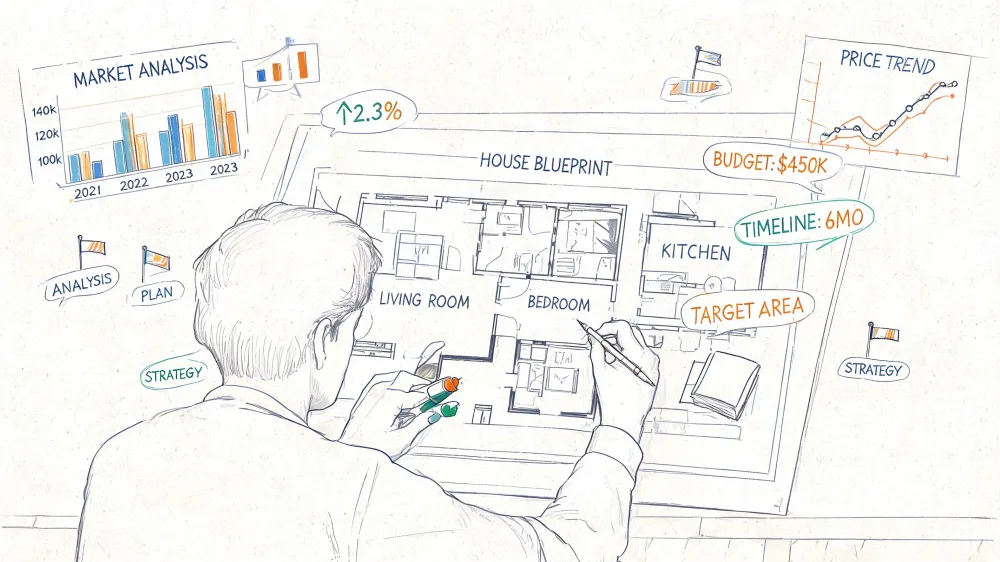
In a rising market, winging it is costly. When prices climb, a general "the market is hot" line convinces no one. A serious negotiator doesn't argue the broad trend — they use local comparables and the property's specific condition to justify a defensible move, typically in the 5–10% range.
Build a case file, not an opinion
Before calling the other party, I prepare a simple, useful file. No need for theatrical, endless reports. You need to arrive with judgement.
That file includes:
- Real comparables. Same area, similar square footage, similar condition, floor, elevator, orientation and age.
- Ad reading. What it promises, what’s hype and what it omits.
- Property condition. What’s visible and what will probably require money or time.
- Client position. How far they can go and what they need in return.
For young agents this is important. Not all comparisons are valid. A renovated flat competes in a different league than one that “can be updated to your taste.” If you mix them, your client buys poorly or sells worse.
Three figures you must set before speaking
I never enter a negotiation with only one number in my head. I work with three.
| Figure | What it means | What it’s for |
|---|---|---|
| Price ideal | The best reasonable scenario | Sets ambition |
| Price target | What makes sense to close | Guides strategy |
| Walk-away price | The exit point | Prevents emotional decisions |
The problem for many buyers isn’t paying too much at the start. It’s falling in love and losing track of their limit. And the problem for many sellers is the opposite: confusing desire with market and only reacting when they’ve already lost valuable time.
If the client doesn’t know their walk-away price, they aren’t negotiating. They’re waiting to see what happens.
Investigate motivation, not just price
A seller’s real motivation is worth more than a poorly used spreadsheet. Some owners prioritise price. Others want speed. Others need certainty because they’ve already bought another home, are handling an inheritance or are exhausted by unproductive viewings.
This isn’t always said directly. It’s detected.
You detect it in details like:
- Changes in discourse. An owner who was inflexible at first and later asks about timelines is revealing priorities.
- Response to timing. If they insist on specific dates, there’s a lever.
- Sensitivity to buyer preparation. Someone who values a clean operation usually rewards seriousness.
The useful logic here is simple: separate the negotiable elements from the structural ones, and make decisions on performance criteria rather than impulse. If you understand what the other side actually needs, you can trade on the points that cost you little and protect the ones that matter.
Visual preparation is also part of the analysis
Many agents still treat the visual side as something decided at the end. Mistake. Presentation influences from minute one because it conditions perceived value and the type of objections that will later arise.
If you handle listings or advise a seller before the property goes live, support your work with an operational checklist for preparing a home for sale. It doesn’t replace your judgement, but it organises a process that directly impacts negotiation.
The agent who prepares well arrives at the table with data, context and a plan. The one who doesn’t ends up reacting to the other party’s narrative.
The Art of the First Offer and the Initial Conversation
The first offer is not a shot in the dark. It’s an anchor. And a poorly placed anchor complicates the whole deal.
A reasonable initial offer — usually within 5–10% of the asking price — keeps the seller at the table and gives you room to move. Offers far below that, with no rationale attached, tend to get rejected outright. The lesson isn’t “always offer the same.” It’s this: if you touch price, do it within a defensible frame.
An example of a well-phrased conversation
Suppose a flat is listed at €200,000. The buyer wants to be aggressive. The novice agent would say: “We offer €170,000 because it needs renovation.” Bad idea. It sounds brusque, vague and unserious.
The professional version sounds like this:
“We’ve reviewed closed comparable sales in the area and the current condition of the kitchen, bathroom and systems. Based on that, we present an initial offer of €180,000, with capacity to move quickly if timelines and conditions align.”
Notice what that sentence does. It doesn’t argue for the sake of arguing. It doesn’t dismiss the property. It doesn’t leave the figure floating. It connects it to market, condition and speed.
Verbal or written
My rule is simple. You can test the waters verbally, but the offer must be formalised in writing when you want it to carry weight.
The written offer orders the negotiation because it makes clear:
- Price offered
- Acceptance deadline
- Payment method or mortgage situation
- Relevant conditions
- Objective reasons supporting the proposal
It also avoids the classic problem of distorted conversations. Between “what the buyer said,” “what the seller understood” and “what the agent recalled,” deals get lost.
How to speak without triggering the owner’s ego
Some phrases close doors. Others open them.
| Instead of saying this | Say this |
|---|---|
| “The house isn’t worth that” | “With the comparables we have, it fits better in this range” |
| “It needs a total renovation” | “The current condition requires updates and that impacts the offer” |
| “That’s a low offer” | “This is a serious, argued offer with willingness to close” |
Tone matters. If you sound defensive you lose authority. If you sound arrogant you break the relationship. Your voice should convey calm—even on the phone.
A good first offer doesn’t try to win the negotiation in a minute. It tries to make the other party want to stay at the table.
The offer needs commercial context
I also teach the team: an offer isn’t supported by the number alone. It’s supported by how you present the buyer.
If they have financing lined up, can sign quickly, accept flexible dates or won’t demand an endless list of changes, that all helps. Sometimes it doesn’t lower the price by itself, but it improves the seller’s disposition.
To structure that reasoning, it helps to review a clear approach to real estate pricing and offer positioning. Not to copy it mechanically, but to sharpen your initial anchor and avoid giving away margin in the first conversation. Knowing the most common mistakes when selling a house is just as useful when you sit on the other side of the table.
Handling Counteroffers and Objections Like a Professional
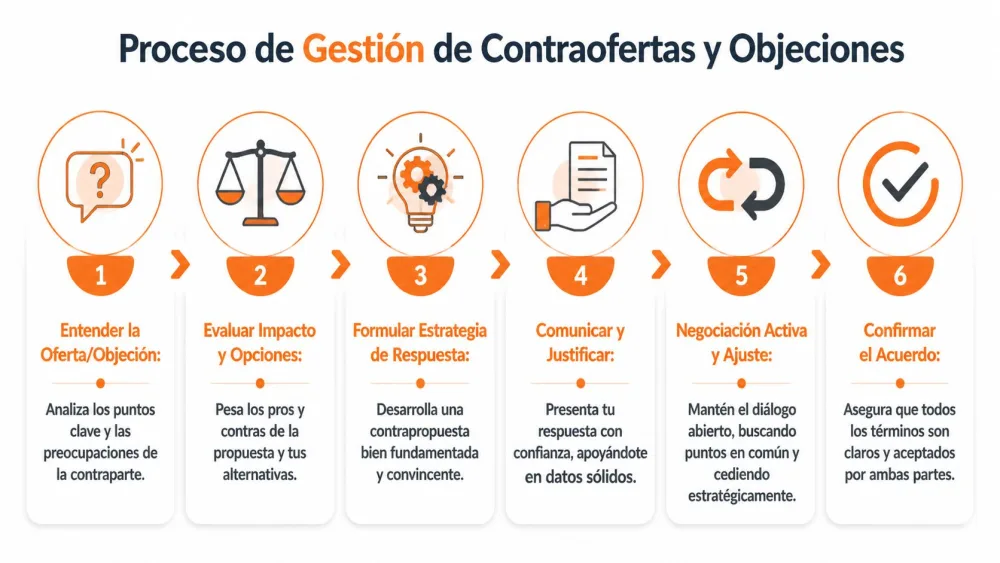
The real negotiation starts when the other party says “no,” “it’s too low” or “we have another offer.” That’s where the nervous salesperson separates from the useful negotiator.
Discounts widen the longer a property sits on the market, and a listing that has been live for months usually signals a seller who is more willing to move. So when you receive a counteroffer, don’t interpret it only as a number. Interpret it as a symptom.
What a counteroffer reveals
Not all counteroffers mean the same thing.
- Small movement. Often indicates the seller is marking territory or is near their psychological limit.
- Large movement. Often signals real margin or a need to activate the sale.
- Stubborn on price but open on terms. They don’t want to look weak, but they do want to sell.
- Slow response. Often indicates internal doubts, not firmness.
The common error is replying too quickly. I prefer to read what message the figure carries first.
Typical objections and correct reading
You hear these phrases every week. The important thing isn’t memorising them. It’s understanding what they hide.
| Seller objection | What it usually means | How to respond |
|---|---|---|
| “It’s too low an offer” | They want to revalue their position | Return to comparables and condition, without arguing |
| “We have more interest” | Seeks pressure or validation | Ask for clarity on timelines and solidity of the other party |
| “We’re not in a hurry” | Protecting pride or testing | Lower urgency and restore calm |
| “We won’t sell for less than X” | Setting an initial frame | Don’t fight the phrase. Negotiate the context |
A seller rarely argues only about money. They argue about control, recognition and fear of regret.
Concession plan
Never give in for free. If you give something, the other party must give something too.
That plan can include:
- Signing date. Sometimes a comfortable closing matters more than a small price difference.
- Inventory. Furniture, appliances or specific items can unblock a deal.
- Small repairs or credits. Useful if the price is close but there’s friction.
- Earnest money. A tidy, well-documented operation carries more weight than an aggressive but poorly tied offer.
When a young agent asks me what to say in a counteroffer, I almost always correct the same thing: don’t say “we can raise it a little.” Say “if we adjust this point, we can revisit our position.” That keeps the exchange balanced.
Silence also negotiates
There are moments when the worst thing you can do is fill the air. Present your argument, stop, and give space.
If you speak out of nerves you give away information. If you hold the silence well, you force the other side to position themselves.
This requires emotional preparation. The buyer wants it resolved now. The seller wants validation. The professional agent holds the tension without rushing. That’s a craft skill.
Your Secret Weapon — Use Visuals to Justify Price and Win
Here’s the advantage many still underuse. Visuals aren’t only for attracting viewings. They help you negotiate better.

Properties with professional visuals tend to sell faster and make overpricing easier to spot. Using a virtual tour or a render to show a needed renovation turns a vague "it needs work" into a concrete, quantified case — and a concrete case is what justifies a lower offer.
How the buyer’s agent uses this
Buyers often make a mistake. They sense something “doesn’t add up,” but can’t translate that feeling into a concrete reduction. That’s where well-used visuals convert a vague impression into a negotiable argument.
If the bathroom is outdated, saying so isn’t enough. It’s worth showing what update that room needs to align with the asking price. If the layout penalises the property, a worked floor plan or a visual proposal helps quantify the issue.
This approach changes the conversation for a simple reason. The other party no longer hears “I want to pay less.” They hear “this price doesn’t reflect the work pending.”
When you make the cost of the potential visible, the reduction stops sounding like opportunism.
How the seller’s agent uses this
It also works the other way round. If you represent the seller, good presentation protects you against unfair comparisons.
Many buyers show comparables that are worse presented, worse photographed or with less clarity about spaces. If your property is better exposed, you can more forcefully defend why it competes at a different level. A 360° tour, clean photos and a coherent visual proposal reduce doubts and shrink the space for purely emotional attacks.
For agents working on positioning and listings, this ties into a broader idea about how to increase a home's value before going to market. Not all value uplift comes from renovation — part of it comes from how you demonstrate that value, and virtual staging is one of the fastest ways to do it.
Visuals that help and visuals that hinder
Not all visual material aids negotiation. Some pieces help, others only decorate.
- Help: clear comparisons between current condition and possible result.
- Help: tours that eliminate ambiguity about layout.
- Help: images that correct bad light or perspective without falsifying reality.
- Hinder: excessive embellishments that create impossible expectations.
- Hinder: renders that look like a different property.
This video sums up well why presentation is already part of the commercial conversation, not just marketing:
The craft trick
When a buyer hesitates, show them the cost of not seeing it clearly. When a seller digs in, show them how their property is perceived against others.
That’s the trick. The right image, at the right time, avoids an abstract argument. And in negotiation, everything that reduces abstraction brings you closer to closing.
Closing: Locking the Deal and Final Tips
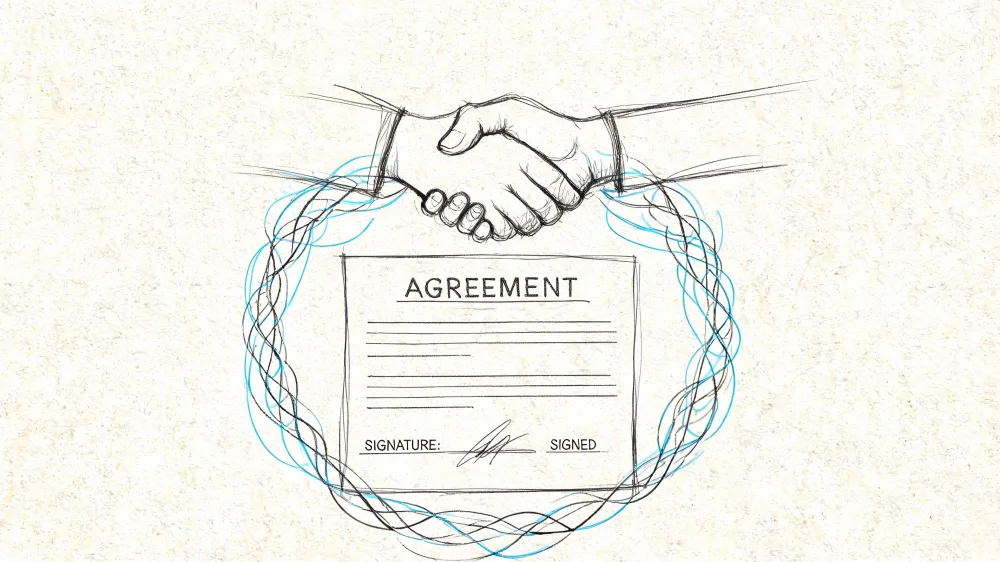
A verbal agreement only truly counts once it's secured in writing. I've seen excellent deals fall apart at the last minute over a misunderstood phrase, an “included” appliance that nobody documented, or a date each side interpreted differently.
Market history offers a useful lesson. In every downturn, the buyers who negotiated firm, well-documented discounts protected themselves from later losses, while those who closed on a handshake and vague promises carried the risk. That’s why the closing isn’t paperwork for paperwork’s sake. It’s protection.
What must be put in black and white
There are four points I never leave to chance:
- Exact final price. No ambiguous rounding or “we’ll see.”
- Timeline. Earnest deposit, signing, and any intermediate milestones.
- Allocation of costs and agreed conditions. Everything in writing.
- Inventory and handover condition. What stays, what’s removed, and in what condition.
This is where professional skill shows. The poor agent relaxes when they hear “agreed.” The good one gets to work.
The most avoidable last-minute failures
They rarely come from major conflicts. They come from small oversights.
| Final mistake | Consequence |
|---|---|
| Failing to document an agreed repair | Dispute before signing |
| Not specifying furniture or appliances | Feeling of being misled |
| Not confirming deadlines with all parties | Unnecessary tension |
| Changing terms at the last minute | Loss of trust |
Closing well is leaving little room for interpretation.
The principle is the same one used in any process where details multiply: when there are many moving parts, written order prevents costly errors. A deal lost to a misread date or an undocumented appliance is never lost over money — it’s lost over discipline.
The advice I repeat most to the team
Don’t chase a theatrical win. Chase a solid agreement.
A well-advised buyer isn’t only trying to pay less. They want to pay what’s right for their context. A well-handled seller isn’t only aiming to get more. They want to close without shocks and feel they made a good decision.
An agent’s reputation is built here. In how they negotiate. In how they protect the deal. In how they prevent a promising transaction from collapsing due to improvisation. If you work like this, you’re not just closing a sale. You’re building trust for years to come.
Want to turn the visual side into a real negotiating advantage? Pedra lets you create enhanced images, virtual staging, videos and immersive tours from ordinary property photos in minutes — so you can show the cost of a renovation, defend a price, or make a listing impossible to dismiss. In a market where perception shapes every negotiation, better visuals aren’t a luxury. They’re part of the job.

Related Posts
How to Market a Real Estate Listing: The 6 Things a Professional Listing Needs
The six assets a professional real estate listing needs — photos, video, virtual tour, floor plan, s...
Best AI Video Tools for Real Estate Agents (2026): Tested and Compared
Nine AI video tools compared for real estate work, with current prices and the one distinction most ...
Best Virtual Staging Software (2026): Seven Tools Compared on Cost Per Listing
Seven virtual staging tools compared with current prices, priced the way you actually buy — per list...
BoxBrownie Virtual Staging Pricing (2026): What It Really Costs Per Image
BoxBrownie charges €30 per image for virtual staging with under-48-hour turnaround. Here's the full ...
Listing Presentation Templates: Win More Clients
Professional listing presentation templates that close deals. Customizable CMA templates, market ana...
Win More Deals with Your Real Estate Listing Presentation
Master your real estate listing presentation to attract clients and close more deals. Learn expert t...