
How to Start a Real Estate Business in 2026: Step-by-Step Guide
Learn how to start a real estate business in 2026 step by step: business plan, legal setup, licensing, marketing and the tools you need to launch an agency.
If you’re reading this, you’re probably at one of two points. Either you’ve been working for another agency and decided you don’t want to depend on someone else’s portfolio anymore, or you come from another sector and see real estate as a real opportunity to build your own business.
Both situations share something. Most people start thinking about sourcing listings and closing sales, when in reality how to start a real estate agency is decided much earlier: in the plan, the legal structure, cash control and, now more than ever, how you present each property visually from day one.
I’ve seen agencies launch with a spotless office and no system. I’ve also seen small, nimble projects enter the market with a clear proposition, orderly operations and a commercial image that inspired confidence from the first online visit. The latter tend to progress faster.
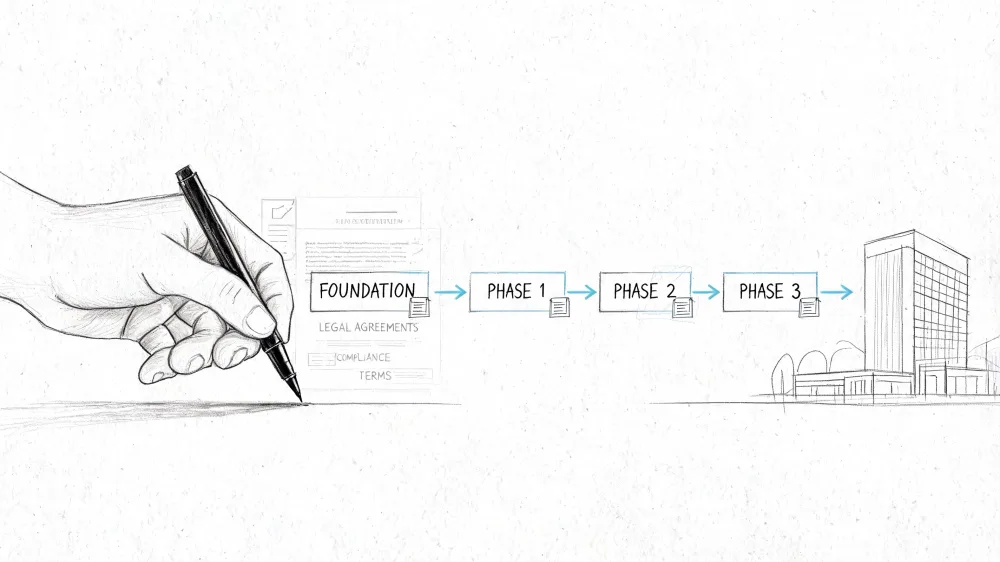
Business Plan and Legal Foundations
The real start of a real estate agency usually looks like this. A potential listing comes in, the owner asks how many properties you already manage, how you will market their property and what structure you have behind you. If at that point you’re still improvising the model, legal form or basic operations, you convey fragility. And in this business trust can be lost before the first signature.
Choose an agency model before you scale
Opening a real estate agency in Spain isn’t just about renting a storefront and posting listings on portals. It’s about deciding what you will actually sell. Lead-generation and listings in a very specific neighborhood, rental management, bank repossession stock, mid-market family homes, investment properties, luxury or inherited estates. Each line requires a different sales rhythm, client type and visual system.
Specialization not only sharpens your sales pitch. It also reduces hidden costs. A generalist agency from day one needs more processes, more contacts, more legal knowledge and more capacity to produce sales materials for very different property types. A niche-focused agency can refine its offer, sourcing and property presentation sooner.
Be blunt here. If you can’t explain in one sentence what your agency does and for whom, the market won’t understand it either.
A useful plan documents four decisions:
- Where you compete. Neighborhoods, municipalities or a realistic radius.
- What operation you master. Sales, rentals, sourcing for investors or full management.
- What type of owner you want to attract. Private sellers, developers, heirs, small investors.
- How you will stand out visually. Photography, video, digital home staging, tours, ads and well-produced listings from day one.
That last point often gets postponed. That’s a mistake. For a new agency, visual quality isn’t a branding ornament. It’s proof of professionalism. If your portfolio hits the market presented better than competitors’, you get more clicks, more viewings and more arguments to win listings. So define in the plan who produces those assets, the turnaround and the cost. If you’re still adjusting commissions and margins, it helps to review how presentation affects positioning and pricing strategy — for example in this guide on real estate pricing and perception of value (https://pedra.ai/blog/real-estate-pricing).
Legal form is chosen by risk and operational pace
The legal form is not chosen for image. It’s chosen for liability, taxation, expected turnover and the ability to bring in staff or partners.
In the early phase many professionals start as sole traders (autónomos) to validate sourcing, close their first deals and avoid burdening the business with a heavier structure than needed. That makes sense when volume is low and the model is being tested. A Sociedad Limitada (SL) fits better when you want to separate personal assets, distribute equity or build an agency with a formal team and processes.
The administration provides clear guidance on incorporation steps, census registration and choosing a legal form on the CIRCE and PAE company creation portal of the Ministry of Industry (https://paeelectronico.es/es-es/crea-tu-empresa/Paginas/crea-tu-empresa.aspx). For fiscal registration, check the procedures for registration in the Censo de empresarios, profesionales y retenedores at the Tax Agency. These sources are more useful than many condensed guides because they help avoid errors in registration and force you to organise the launch.
Then there’s the part many delay that later blocks activity: municipal licences, insurance, data protection, client engagement letters, data-processing agreements with suppliers and, depending on the autonomous community, registration or specific requirements to operate. In Catalonia, for example, the AICAT registry remains an operational reference for those who intermediar professionally. The point is not to accumulate paperwork. The point is to be able to source, advertise and invoice without leaving open legal gaps.
The premises are not the first decision, but they are an operational and legal decision
I’ve seen agencies sign a lease too early for an emotional reason. They wanted to “look” like an established agency. Then come adaptation costs, utilities, signage, licences and dead time.
If you’re opening an office, check three things first: permitted use of the premises, a realistic opening timeline and the cost to make it operational. In that setup, arranging business electricity (https://www.evenergia.com/blog/dar-de-alta-la-luz/) often seems a minor detail, but it affects schedules, works and move-in dates. Solving it late delays everything else.
An agency can launch without a street-front office. What it cannot launch without is a document system, clear commercial terms and a consistent way to present properties.
What should be written down before you start sourcing seriously
A small agency’s business plan doesn’t need fifty pages. It needs decisions you can use on Monday.
Include at minimum:
- A concrete commercial proposition. What problem you solve and for which client.
- A limited operating area. Where you can defend price, timings and message.
- Chosen legal form and a schedule of formalities.
- Fee and exclusivity policy.
- Sourcing process. Valuation, pitch, signing and property registration.
- Visual system. Who creates photos, video, portal assets and brand materials.
- Criteria to accept or reject properties. An inflated inventory of unmarketable stock consumes time and damages your image.
A good plan doesn’t impress by grand promises. It works because it avoids costly decisions, protects operations and makes clear something many new agencies discover late: competitive advantage is no longer just in getting properties, but in presenting them better and faster than the rest.
Realistic Budget and Financial Projections
You open in January, sign two engagements in February and March looks promising. Then a sale is delayed by financing, another falls through at contract stage and you keep paying portals, CRM, travel and advertising. Financial pressure for a new agency rarely comes on opening day. It arrives in the first six months, when you haven’t yet converted activity into steady cashflow.
What it really costs to launch
The budget varies by model, city and the level of structure you bring to market. A street-front agency needs more capital for deposit, fitting-out, furniture, signage and utilities. A lightweight model with a small office or hybrid operation reduces that burden and allows you to allocate more funds to sourcing, visibility and product marketing.
If you’re considering a franchise, carefully review what you’re buying. The OCU guide on franchises helps order that decision: entry fees, royalties, operational limits, brand dependence and the real margin after paying for structure. I’ve seen offices open with impeccable branding and little commercial flexibility. I’ve also seen well-focused small agencies with better cost control reach breakeven sooner.
The office impresses less than many think. What weighs from month one is the sum of fixed commitments you accept without having stabilised sourcing or closings.
Cost Estimate to Start a Real Estate Agency in Spain
| Concept | Cost Online Model | Cost Physical Agency |
|---|---|---|
| Incorporation and launch | Low, with minimal structure | Higher, depending on legal form, premises and fit-out |
| Premises and fit-out | N/A or minimal | Variable depending on location, condition and renovation |
| Monthly rent | N/A or minimal | One of the main fixed costs |
| Technology and marketing | Core part of the investment | Core part of the investment |
| Franchise fees | Added if you choose this model | Added if you choose this model |
Use this table to build scenarios, not to generate a misleading average.
Distinguish one-off costs from recurring costs
Be disciplined here. If you mix everything into a single figure you lose visibility and make bad decisions.
Start-up costs
- Company incorporation
- Licences and insurance
- Equipment
- Deposit or lease guarantee
- Initial brand identity
- Technology setup
- Initial marketing materials
Monthly costs
- Rent
- CRM and tools
- Property portals
- Advertising
- Telephony
- External collaborators
- Utilities
- Travel
- Visual production for listings
That last item is often under-calculated. Many new agencies budget portals and ads but leave the real cost of photos, editing, video, social assets, campaign creatives and marketing materials vague. Then the problem appears. They source more properties than they can present well, or they present slowly and lose impact in the first days of publication. That’s why I insist on reserving a specific line for the visual engine from the start. Not as a branding luxury, but as a direct part of conversion.
I also recommend keeping cash reserves for several months of operation. A sensible projection anticipates delays in closings, fees arriving later than expected and periods with lots of activity but little cash inflow.
A well-prepared budget covers the opening and also the months when a deal moves, but the portal invoice still arrives.
How to project revenues without fooling yourself
A useful projection starts with your area, your average ticket and your likely rate of exclusive listings. Not with the best-case scenario. The Consejo General del Notariado publishes data on average prices and sales trends that can ground expectations by territory in their real estate statistics. With that base you can build a less intuitive estimate.
Make three scenarios:
- Conservative. Few listings, slow closings and sustained commercial spend.
- Base. A reasonable pace for a new agency with a clear focus.
- Ambitious. More sourcing and better conversion, without assuming everything listed sells quickly.
Then calculate how many net deals you need to cover overhead. If your total monthly cost is €4,000, it’s not enough to know how much you charge per sale. You need to know how long it takes to invoice, what percentage you share, how many engagements fall through and how much it costs to bring each property to market with a standard that helps sell.
This leads to another decision that affects margin and positioning. Before setting fees, study how to define a profitable and defensible real estate pricing strategy (https://pedra.ai/blog/real-estate-pricing) so you don’t copy the corner competitor’s fee without understanding what service is included, what cost you absorb and what commercial promise you can keep.
For a new agency, surviving doesn’t only depend on selling. It depends on getting paid regularly, protecting margin and choosing carefully where you put every euro from month one.
Your Visual Engine and Marketing from Day Zero
Most guides on how to start a real estate agency talk about a website, CRM, logo and portals. All that matters. But they often leave out the real bottleneck you’ll feel in the market: producing quality visual assets consistently.

Reviewed guides dedicate less than 5% of their content to visual marketing tools, and that omission matters because the cost of visual production can represent 15–25% of the initial marketing budget (according to this analysis on the visual marketing gap for agencies: https://inmocms.com/como-montar-una-real estate agency-en-7-pasos/).
The problem isn’t just taking photos
A new agent often thinks about hiring a photographer only when they secure an important listing. The issue is that today you don’t compete only with good photos. You compete with a complete presentation experience.
Buyers expect, at minimum, a well-lit, well-styled and well-narrated property. In many cases they also expect video, a walkthrough, context and potential. Without that, a listing feels weak even if the property is good.
There are four common bottlenecks:
- Time. Coordinating photographer, video, editing and delivery slows market launch.
- Cost. Each visual assignment adds up and weighs more on agencies still starting out.
- Consistency. A portfolio looks professional when all properties meet a standard.
- Scalability. What works with three properties can break with fifteen.
A small agency doesn’t need to look huge. It needs to look serious, fast and visually cared for.
What your visual engine should provide
When I say visual engine, I’m not talking about a nice extra. I mean an operational piece that affects sourcing, listings and brand perception.
Your visual system should allow you to:
- Improve base photos to correct light, perspective and overall presentation.
- Create property video without always relying on full shoots.
- Generate virtual tours to share a clear walkthrough before a physical visit.
- Show potential for vacant or dated properties with virtual staging or renovation proposals.
- Adapt assets for social and portal formats without redoing the work each time.
If you don’t solve this from the start, you end up improvising. And it shows. A weak listing not only fails to attract buyers. It also signals to the owner that your agency isn’t prepared to defend their property over the competition.
To better understand how this format fits into sourcing and presentation, it’s worth reviewing examples of virtual tours for real estate agents (https://pedra.ai/blog/virtual-tours-for-realtors).
What works and what doesn’t
It works to start with a simple standard and repeat it. It doesn’t work to wait to have a big portfolio before professionalising the presentation.
Tends to work
- Define a fixed sequence of materials per listing.
- Use the same visual template for social, the property dossier and the listing.
- Prepare vertical and horizontal versions of each asset.
- Have a ready visual proposal for vacant or fixer properties.
Tends to fail
- Publish first and “improve later”.
- Commission each asset from a different supplier.
- Produce assets without brand identity.
- Reserve visual effort only for premium properties.
This type of asset helps explain why visual content is no longer optional:
Your competitive advantage starts before the viewing
Many agents believe their best weapon is negotiation. I would say it starts earlier. It starts at sourcing, when you show the owner how you will present their property. And it continues with the buyer’s first digital impression.
If your agency can show a vacant home looking better, turn basic photos into a polished commercial piece and publish quickly without losing quality, you enter the market with an operational advantage. That advantage doesn’t depend on more years. It depends on working better.
Building Your Brand and Getting Your First Clients
The first client rarely arrives because of a brilliant campaign. They usually come from proximity, trust and repetition. People need to remember your name and quickly understand why they should call you.

Spain has already shown that the real estate sector can move huge volumes when credit, demand and confidence align. Between 2000 and 2007 house prices doubled, and in December 2006 a peak of 865,561 new-build housing permits was reached according to this historical review of the Spanish market. You don’t need another boom to learn a useful lesson: when the market heats up, those already well positioned in their area win.
Local brand before grandiose branding
Don’t start with a complex name or a logo that tries to look like an international developer. Start with something sustainable.
Your brand needs to convey three things:
- Clarity. Make clear what you do and where you operate.
- Trust. Property owners should see order, not improvisation.
- Memorability. Neighbours should be able to recommend you without hesitating over the name.
Google Business Profile is a basic piece. If you work in a specific area, that listing can bring calls long before your website has authority. Consistency across name, phone, services and posts matters more than a sophisticated design.
Your first thirty commercial days
Act with intensity, not scattergun efforts. What gets results early on is usually simple and very human.
- Activate your close circle. Friends, family, former colleagues, building managers, lawyers and advisors should know exactly what service you offer.
- Prepare a listing pitch dossier. It doesn’t need to be long, but it should look professional and explain your method.
- Build alliances. Inheritances, divorces, relocations and wealth transfers create opportunities if other professionals trust you.
- Publish useful local content. Not just listings — also context, advice and local activity.
If you want a more systematic commercial approach, there are actionable ideas in this guide on B2B sales in 2026, especially on converting lukewarm contacts into real conversations.
You don’t need thousands of contacts at the start. You need the right people to know you’ve opened and what problem you solve.
Listing acquisition starts long before asking for exclusivity
The typical mistake of a new agent is to approach an owner with only a generic promise: “I’ll get the property moving.” That’s no longer enough. Owners want to see a method.
Your initial pitch should include:
- How you present the property
- How you filter buyers
- How you report progress
- How your listing differs from the rest
- What materials you deliver to support the asking price
It also helps to review concrete approaches for getting clients for a real estate agency and adapt only what fits your area and service model.
Daily Operations and Team Growth
You open the office, two leads come in from Idealista, an owner asks for a valuation that afternoon and a buyer messages to move a viewing from 18:00. If you don’t have a method, the problem isn’t volume. The problem is you start losing money on small invisible tasks.
In a young agency, disorder doesn’t usually come from lack of effort. It comes because everything depends on the founder’s memory. I’ve lived it. For a few weeks it seems enough to remember who wanted a terrace, which flat was pending a title search, or which owner wanted to review the price after the weekend. Then several operations coincide, portal messages, email and phone communications mix, and service suffers.
That’s why you should build daily operations as a system from month one. A CRM and your Google business profile help organise acquisition, follow-up and local visibility. Google explains in its Google Business Profile documentation how to manage a business presence in Search and Maps — and in real estate that impacts both trust and inbound calls.
Processes to lock down from the start
You don’t need a large team to work with discipline. You need repetitive tasks to follow a clear sequence so anyone can follow them without improvisation.
Start with four fronts:
- Lead intake. Record origin, budget, area, urgency and next action.
- Property onboarding. Always use the same sheet, with documentation, commercial status and pending visual materials.
- Buyer and owner follow-up. Keep traceability of calls, viewings, objections and commitments.
- Closing and after-sales. Reservation, document coordination, notary, issues and review requests.
Here’s a point many guides overlook. The bottleneck is often not only commercial. It’s visual. If every property depends on chasing photos, retouching materials, redoing listings and asking for last-minute assets, publication is delayed and acquisition loses momentum. A small agency competes better when it solves its visual engine early: consistent photos, portal-ready versions, social assets and capture materials available without stalling operations.
The CRM organises the commercial relationship. The visual engine speeds market entry and improves how owners perceive your service.
What the founder should do and what to delegate first
In the early phase, the founder usually closes better than anyone. They know the area, understand the listing pitch and spot owners’ real objections sooner. That’s why the first useful hire isn’t always another salesperson.
Often it’s more cost-effective to bring operational support: someone who removes daily friction and lets the founder focus on three revenue-moving tasks: acquiring listings, negotiating and managing live opportunities.
That profile can take on:
- Publishing and updating listings
- Document review
- Scheduling and viewing coordination
- Internal task follow-up
- Entering data into the CRM
- Preparing commercial and visual materials
If your office deals with inheritances, arrears or sales with conflict, have clear references so you’re not responding from memory on sensitive issues. In that context, this Guía de CERTIDEMANDA can help explain to clients, in clearer language, what a foreclosure entails and what limits your role as an agency has.
Healthy growth shows up in something very concrete
You notice it when an operation doesn’t fall apart because you have a bad day or because you’re out showing another property.
That requires writing down decisions that initially seem obvious: when a lead becomes active follow-up, what visual materials are prepared at onboarding, when to propose a price adjustment, how the owner is informed after each viewing and what conditions make you drop a listing that will only consume time.
Documenting this improves business quality. It also changes hiring. You no longer look for “someone who helps with everything.” You look for a person for a defined process, with defined tools and a specific service level.
That’s when a real estate agency starts to grow. Not when it accumulates tasks, but when it can handle more properties, more clients and more listings without losing control or market presence.
Your Final Checklist and Launch Timeline
If you want to avoid chaos, you need a clear sequence. You don’t have to do everything at once. You have to do it in the right order.
Opening checklist
Review this list before launching:
- Legal structure finalised. Chosen legal form, registrations completed, licences reviewed and insurance active.
- Operational business plan. Niche, area, services and acquisition criteria defined.
- Budget under control. Start-up costs and monthly expenses separated.
- Tools ready. CRM, website, email, Google Business Profile and publication system.
- Commercial identity prepared. Name, logo, dossier, templates and pitch.
- Visual system resolved. Clear workflow for photos, video, tours and sales presentations.
- Network activated. Collaborators, close circle and local partners informed.
- Commercial process documented. From lead to closing.
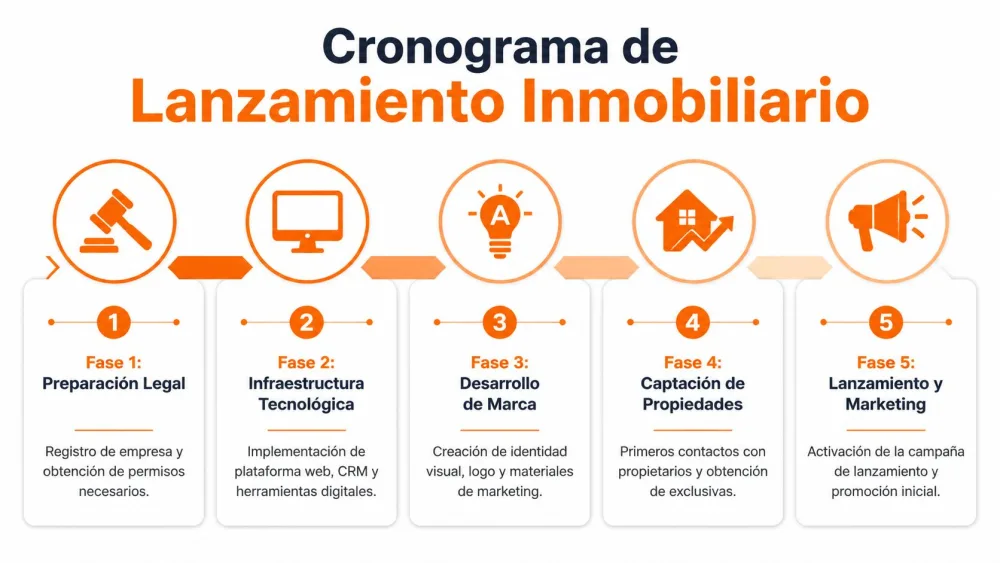
A simple timeline that keeps you moving
It works well to order the launch into three work blocks.
First block Resolve the legal side, company structure, financial forecasts and model decisions. Don’t chase volume here. Chase clarity.
Second block Build brand presence, website, CRM, local profile and the visual system you’ll use to show properties and acquire owners. The agency doesn’t need noise yet. It needs coherence.
Third block Activate market launch. Networking, calling, alliances, first listings, publications and constant follow-up. Now you’re not building an idea — you’re opening an operation.
If one part bogs you down, it’s rarely lack of ability. It’s usually trying to start marketing, sales and structure all at once.
Building an agency today requires mixing traditional craft with new tools. Knowing your area, negotiating well and taking care of clients still matters. But so does launching listings with impeccable presentation, working systematically and building an operation that doesn’t depend solely on your energy.
If you want your agency to go to market with a strong visual standard from day one, Pedra helps turn property photos into enhanced images, videos, virtual tours and commercial materials ready to publish. It’s a practical way to build that visual engine without relying on multiple providers or editing skills.

Related Posts
How to Market a Real Estate Listing: The 6 Things a Professional Listing Needs
The six assets a professional real estate listing needs — photos, video, virtual tour, floor plan, s...
Best AI Video Tools for Real Estate Agents (2026): Tested and Compared
Nine AI video tools compared for real estate work, with current prices and the one distinction most ...
Best Virtual Staging Software (2026): Seven Tools Compared on Cost Per Listing
Seven virtual staging tools compared with current prices, priced the way you actually buy — per list...
BoxBrownie Virtual Staging Pricing (2026): What It Really Costs Per Image
BoxBrownie charges €30 per image for virtual staging with under-48-hour turnaround. Here's the full ...
Listing Presentation Templates: Win More Clients
Professional listing presentation templates that close deals. Customizable CMA templates, market ana...
Win More Deals with Your Real Estate Listing Presentation
Master your real estate listing presentation to attract clients and close more deals. Learn expert t...